
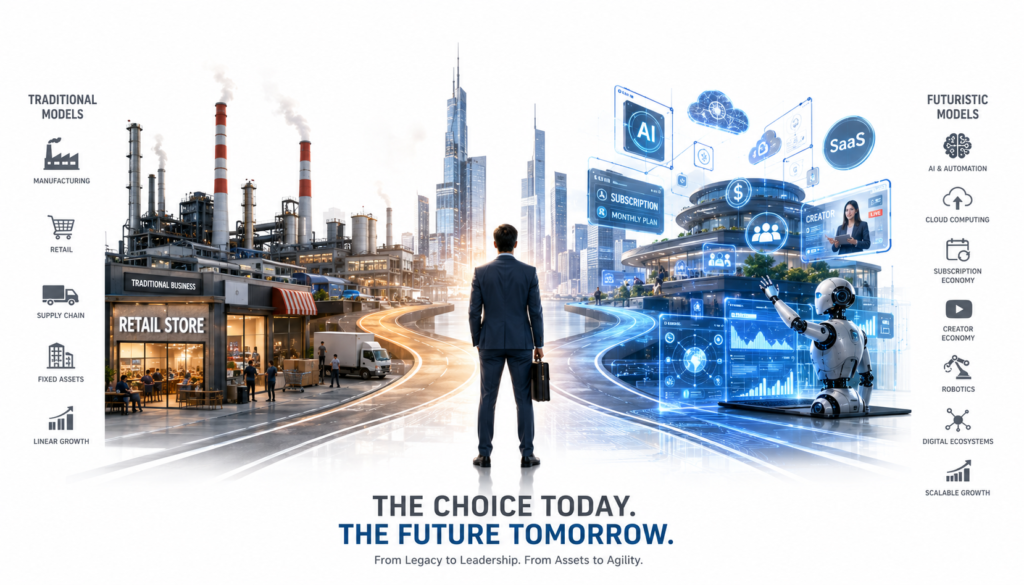
For the first time in modern history, the manner in which businesses generate value is undergoing a rapid transformation.
Throughout the decades, businesses have relied on well-established business models. Products were sold by manufacturers. Retailers sold inventory. Service providers typically charged by the hour. Software companies sold perpetual licences. Success was largely driven by scale, distribution, and operational efficiency.
Today, these conventional models are being challenged.
Business operations have been fundamentally transformed by technologies such as artificial intelligence, cloud computing, automation, digital platforms, changing customer expectations, and global connectivity.
Customers frequently purchase more than just products.
They expect:
- Experiences
- Convenience
- Personalisation
- Continuous value
Because of this, entirely new business models are emerging across a variety of industries.
During the next decade, organisations that adapt quickly will lead, while those that fail to evolve risk becoming irrelevant.
“The greatest danger in times of turbulence is not the turbulence—it is to act with yesterday’s logic.”
— Peter Drucker
Why Business Models Matter More Than Ever
Product development is a primary focus for many entrepreneurs.
Others concentrate on funding.
Some invest heavily in marketing.
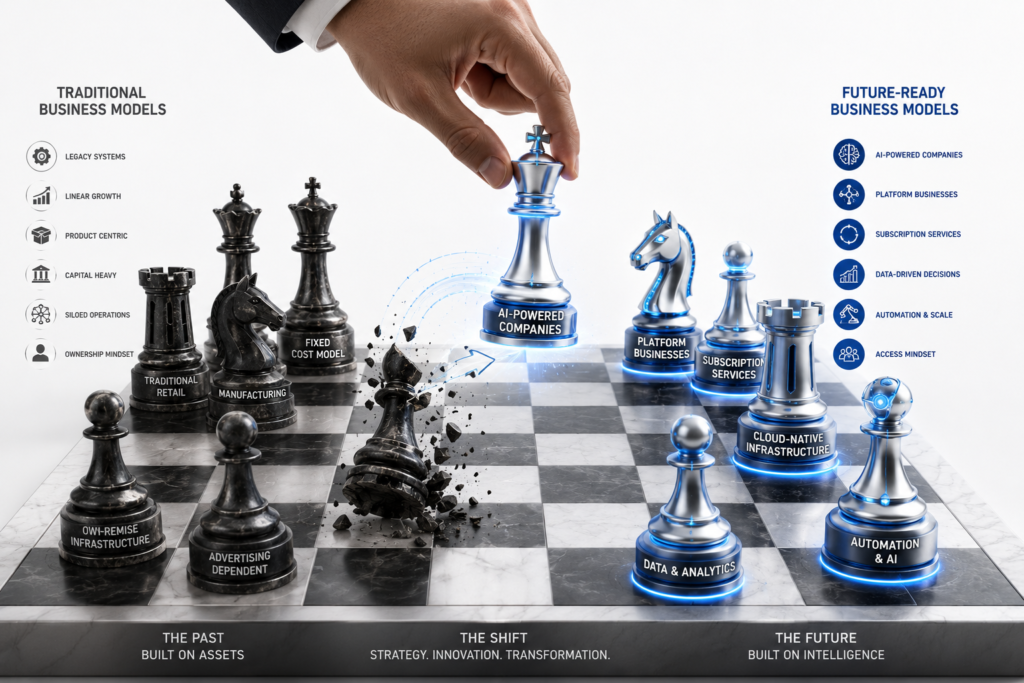
However, despite the fact that these aspects continue to be important, history has repeatedly shown that the business model itself is frequently the determining factor in long-term success.
A superior product can still struggle if it is supported by the wrong business model.
An average product backed by a highly scalable business model has the potential to become an industry leader.
The world’s most valuable companies have not simply developed superior products.
They have developed better ways of delivering value.
Management thinker Harvard Business Review has long argued that sustainable competitive advantage increasingly comes from business model innovation rather than product innovation alone.
Choosing the right business model has become just as important as building a great product. Investors today increasingly evaluate whether a business can scale efficiently, generate recurring revenue and build long-term value. Explore our analysis of the startup ideas investors are most excited about in 2026.
The Growth of Subscription Businesses
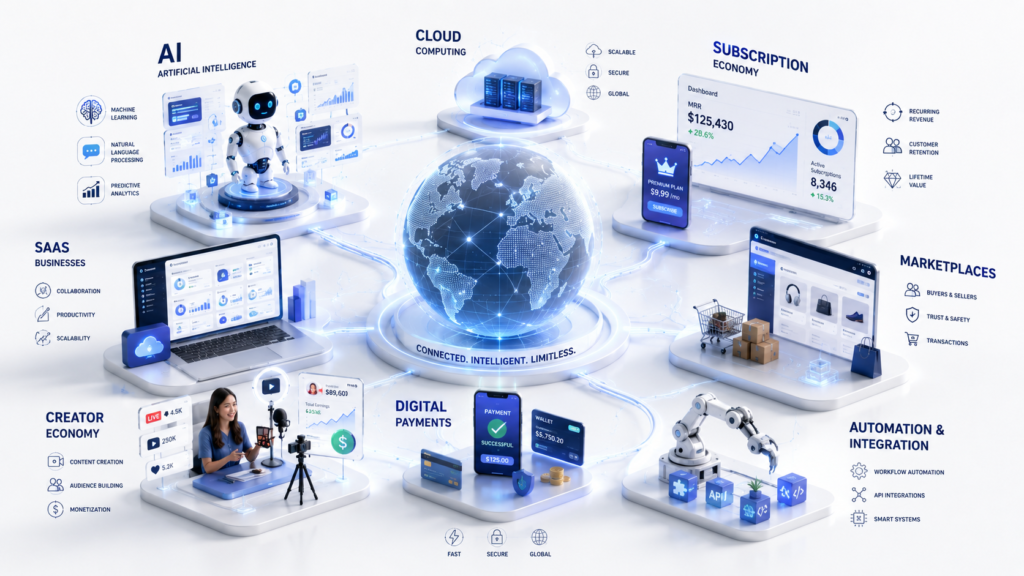
Subscription-based businesses continue to grow across industries.
Consumers increasingly prefer predictable, recurring services over one-time purchases.
Subscription models offer businesses:
- Recurring revenue
- Stronger customer relationships
- Better forecasting
- Higher customer lifetime value
- Improved customer retention
Industries adopting subscription models include:
- Software
- Education
- Healthcare
- Fitness
- Entertainment
- Professional services
- Automotive
- Consumer goods
The subscription economy is expected to continue expanding as businesses focus more on long-term customer relationships than individual transactions.
“Disruptive innovation changes not just products—but entire business models.”
— Clayton Christensen
Artificial Intelligence as a Service (AIaaS)
Artificial intelligence is no longer limited to technology giants.
Businesses of every size increasingly require AI capabilities.
Rather than building expensive AI infrastructure internally, companies are choosing AI-as-a-Service platforms.
These services provide:
- AI assistants
- Predictive analytics
- Automation
- Content generation
- Customer support
- Data analysis
This model enables organisations to access enterprise-grade AI without making significant upfront investments.
As AI adoption accelerates, AI-as-a-Service has the potential to become one of the fastest-growing business models worldwide.
Research from McKinsey & Company suggests that Artificial Intelligence has the potential to transform productivity across virtually every industry over the coming decade.
Artificial Intelligence is rapidly becoming a core business capability rather than a competitive advantage. Businesses across industries are already using AI to automate workflows, improve productivity and enhance customer experiences. Discover the AI tools every business should use in 2026.
Platform Businesses
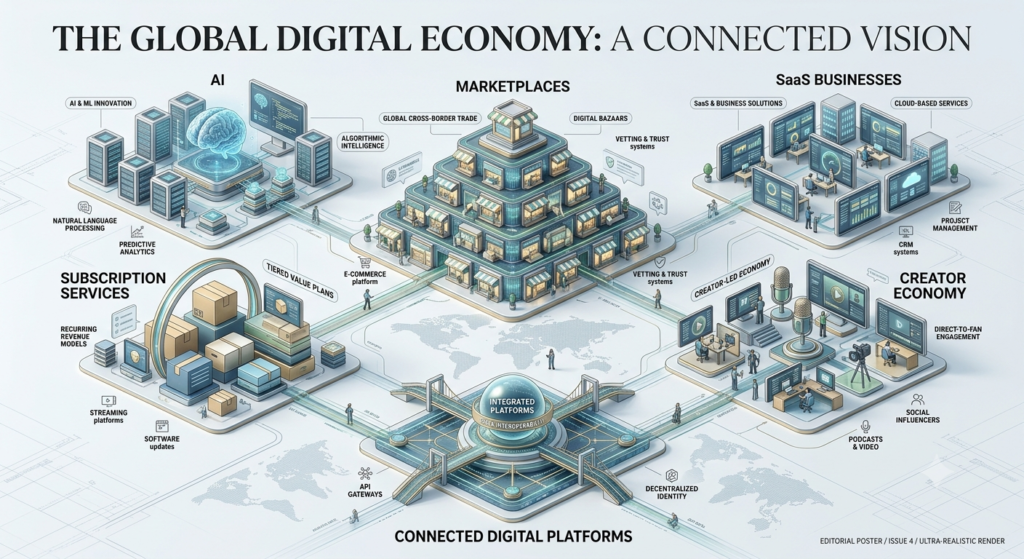
Platform companies connect buyers and sellers instead of owning all the assets themselves.
Rather than producing everything directly, they create ecosystems where participants generate value.
Examples include:
- E-commerce marketplaces
- Freelance platforms
- Food delivery platforms
- Travel booking platforms
- Financial marketplaces
Platform businesses benefit from powerful network effects.
As more users join the platform, it becomes increasingly valuable for everyone involved.
This scalability often creates significant competitive advantages.
“Competition is no longer between products. It’s between ecosystems.”
— Adapted from Michael Porter-inspired competitive strategy principles
Digital platforms continue reshaping global industries. Insights published by the World Economic Forum highlight how platform ecosystems are becoming central to future economic growth.
Marketplace Models
Online marketplaces continue to transform industries.
Unlike traditional retailers, marketplaces focus on connecting supply and demand.
Some advantages include:
- Lower inventory requirements
- Faster expansion
- Multiple revenue streams
- Scalable operations
- Wider product selection
Marketplace opportunities continue to expand across industries such as:
- Healthcare
- Education
- Logistics
- Manufacturing
- Consulting
- Agriculture
- Professional services
Industry research from Gartner continues highlighting the growing importance of digital marketplaces and platform ecosystems for modern enterprises.
Marketplace businesses continue attracting significant investor interest because of their scalability and network effects. Our latest report on startup funding trends in India highlights how capital continues flowing into technology-enabled business models.
The Creator Economy
Technology has enabled individuals to build businesses around their expertise.
Content creators, educators, consultants, designers, developers, and influencers are increasingly operating independent businesses.
Common revenue sources include:
- Digital products
- Memberships
- Online courses
- Brand partnerships
- Communities
- Premium content
- Coaching
- Events
The creator economy demonstrates how personal expertise has become a valuable business asset.
The creator economy reflects a broader shift toward entrepreneurship built on specialised expertise and digital-first business models. Founders looking to build similar ventures should also understand the principles covered in our startup fundraising guide for Indian entrepreneurs.
Outcome-Based Business Models
Customers increasingly prefer paying for results rather than effort.
Businesses are moving away from hourly billing and towards performance-based pricing.
Examples include:
- Marketing agencies charging for qualified leads
- Consultants compensated based on measurable outcomes
- Recruitment firms paid for successful hires
- Software providers charging based on performance or usage
Outcome-based pricing aligns business incentives with customer success.
Usage-Based Pricing
Many companies are shifting from fixed subscription fees to charging based on actual usage.
Customers pay only for what they consume.
Examples include:
- Cloud computing
- Data storage
- API services
- Payment processing
- Telecommunications
This pricing model offers greater flexibility while encouraging wider adoption.
Usage-based pricing is increasingly common among SaaS and AI startups because it aligns pricing with customer value while improving scalability. Investors often favour companies with flexible and predictable revenue models, particularly within enterprise software.
Community-Led Businesses
Communities are becoming valuable business assets.
Instead of relying solely on advertising, companies are increasingly building engaged communities around their products.
Communities help organisations:
- Generate referrals
- Increase customer loyalty
- Gather customer feedback
- Improve retention
- Reduce acquisition costs
Businesses with strong communities often experience sustainable long-term growth.
Data-Driven Business Models
Data has become one of the world’s most valuable business assets.
Businesses increasingly use data to:
- Improve products
- Personalise customer experiences
- Predict customer behaviour
- Optimise pricing
- Improve decision-making
Companies that transform data into actionable insights gain significant competitive advantages.
Data has become one of the world’s most valuable strategic assets. Deloitte continues highlighting how data-driven organisations consistently outperform competitors through better decision-making.
Sustainability as a Business Model
Environmental responsibility is increasingly becoming a commercial opportunity rather than simply a compliance requirement.
Consumers are more likely to support businesses that demonstrate sustainable practices.
Future business models increasingly incorporate:
- Circular economy principles
- Renewable energy
- Waste reduction
- Carbon accounting
- Sustainable sourcing
Businesses that integrate sustainability into their operations often improve both profitability and brand reputation.
The transition toward sustainable business models is accelerating worldwide. The International Energy Agency (IEA) continues highlighting how clean technologies are reshaping industries and investment priorities.
Sustainability is becoming a commercial opportunity rather than simply a compliance requirement. Businesses aligning innovation with long-term environmental responsibility are increasingly attracting both customers and investors. Read our feature on India’s next economic revolution.
Direct-to-Consumer (D2C)
Technology has reduced dependence on conventional retail channels.
Increasingly, brands are selling directly to customers through digital platforms.
Advantages include:
- Higher profit margins
- Customer ownership
- Better data collection
- Personalised experiences
- Faster innovation
Direct relationships enable businesses to respond more quickly to changing customer preferences.
Technology has dramatically reduced barriers to market entry for entrepreneurs. Government initiatives and digital infrastructure are creating favourable conditions for businesses to scale nationally and internationally. Learn more about the Make in India success stories driving India’s manufacturing and innovation ecosystem.
Micro-SaaS Businesses
Smaller, specialised software companies are becoming increasingly popular.
Rather than building large enterprise platforms, entrepreneurs are creating focused solutions for specific business problems.
Advantages include:
- Lower development costs
- Faster launches
- Predictable recurring revenue
- Global scalability
- Lean operations
Micro-SaaS presents attractive opportunities for independent founders.
The rapid expansion of cloud computing continues creating opportunities for specialised software companies. Research from Google Cloud demonstrates how cloud-native businesses are driving innovation across sectors.
Micro SaaS businesses are increasingly popular because they solve niche customer problems while generating predictable recurring revenue. Understanding how investors evaluate these businesses can improve fundraising success. Explore the most active venture capital firms in India.
Hybrid Business Models
Many successful organisations no longer rely on a single source of revenue.
Instead, they combine multiple business models.
Revenue may come from:
- Subscriptions
- Advertising
- Premium services
- Consulting
- Training
- Digital products
- Licensing
Diversification improves resilience during periods of economic uncertainty.
AI-Native Businesses
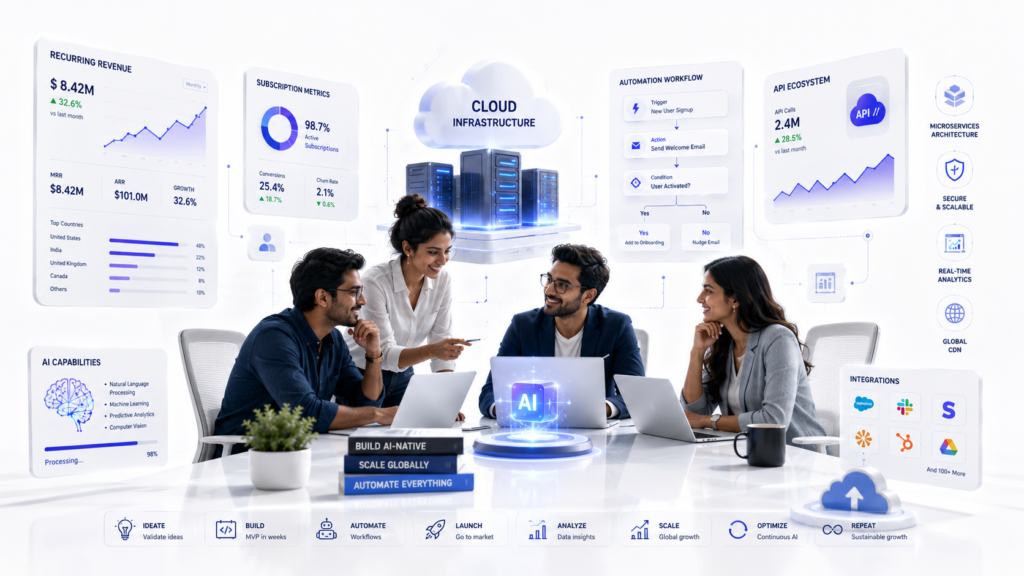
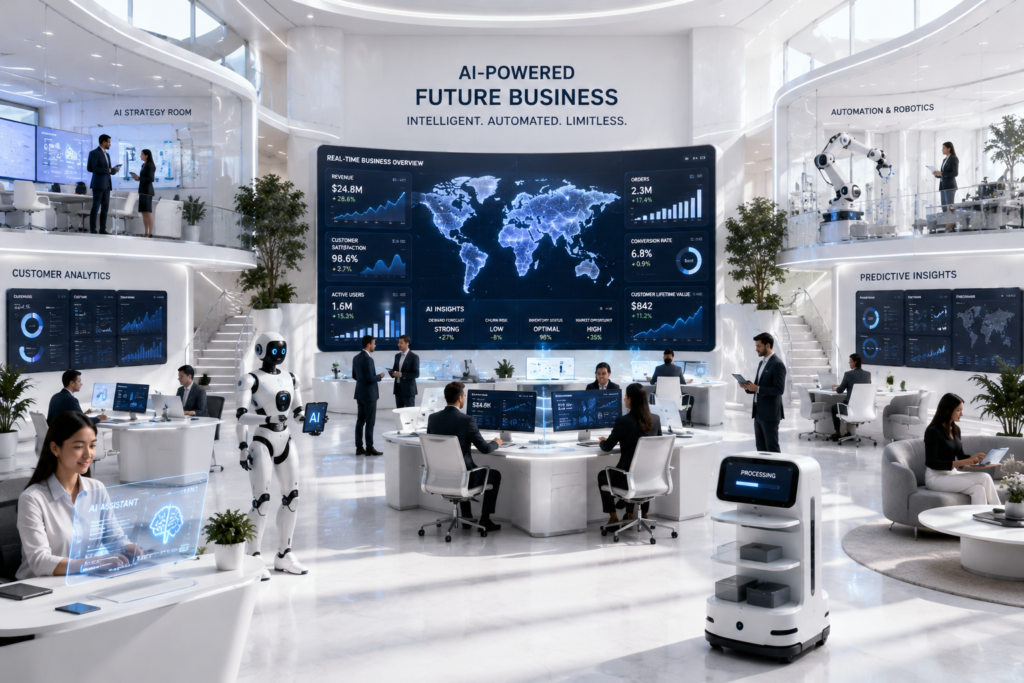
Perhaps the most significant emerging model involves businesses built around artificial intelligence from day one.
Rather than adding AI later, these companies design every process around intelligent automation.
Typical characteristics include:
- Smaller teams
- Faster execution
- Lower operating costs
- Greater scalability
- Continuous optimisation
This model could redefine entrepreneurship over the next decade.
“Every company will become an AI company.”
— Jensen Huang, NVIDIA
According to NVIDIA, AI is becoming foundational infrastructure for businesses across manufacturing, healthcare, finance and logistics.
AI-native businesses are already transforming industries such as logistics, manufacturing and customer service. One example is how AI is helping Indian logistics startups reduce delivery costs through automation and predictive analytics.
The Human Advantage
Businesses must remember one fundamental truth, even as technology continues advancing rapidly.
Technology alone rarely creates a lasting competitive advantage.
The businesses that combine technology with:
- Trust
- Strong customer relationships
- Ethical leadership
- Creativity
- Human-centred design
- Exceptional customer service
will continue building the strongest brands.
The future belongs to businesses that successfully integrate technology without sacrificing the human connection.
Where Entrepreneurs Should Focus
Entrepreneurs starting businesses today should ask themselves several important questions:
- Can this business scale efficiently?
- Does it generate recurring revenue?
- Can AI improve operations?
- Is customer retention built into the model?
- Can technology reduce costs?
- Does the business create long-term value?
- Can it expand internationally?
The answers to these questions may determine future success.
“It’s always Day One.”
— Jeff Bezos
Global economic competitiveness increasingly depends on innovation, productivity and technology adoption. Reports from the OECD continue emphasizing the importance of innovation-led growth.
Final Thoughts
Every major economic transformation creates new winners.
The coming decade will be no different.
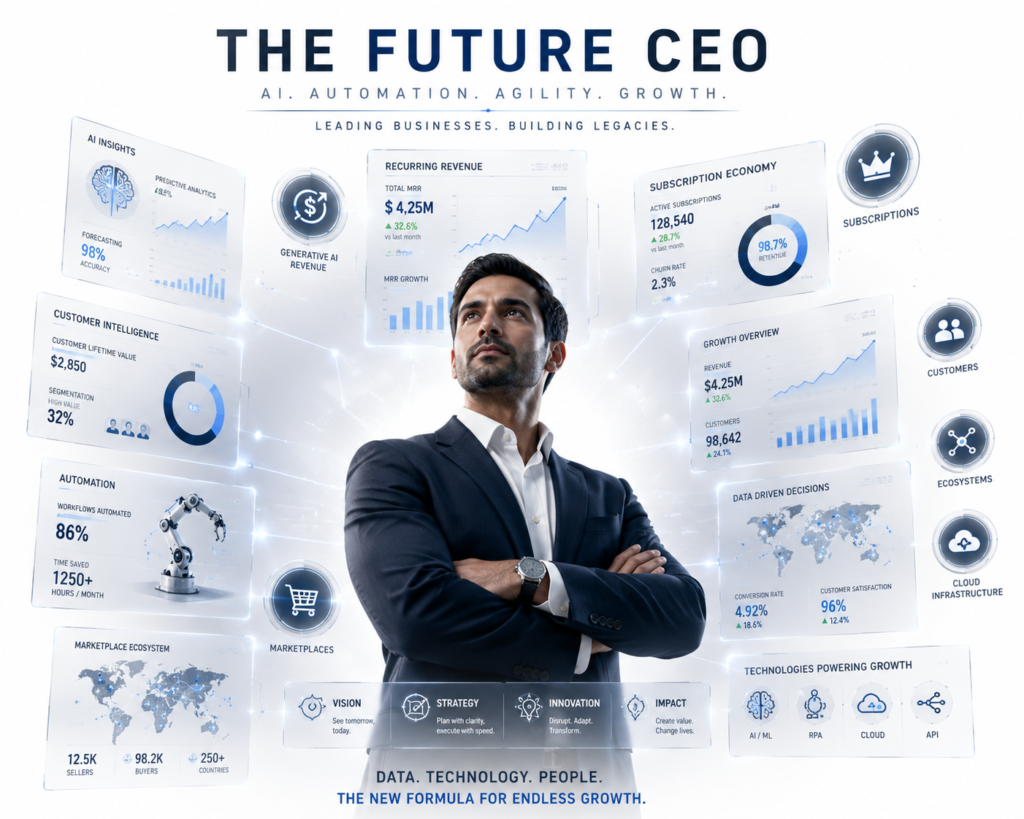
Artificial intelligence, automation, digital platforms, recurring revenue, sustainability, and data-driven decision-making are reshaping industries around the world.
The companies that succeed will not simply build better products.
They will build better business models.
For entrepreneurs, this presents an extraordinary opportunity.
Organisations that continuously innovate, embrace technology, remain customer-focused, and adapt faster than the market around them will shape the future.
As India’s digital economy continues to expand, businesses built on modern, scalable, and resilient business models will play a defining role in the country’s next phase of economic growth.
The businesses of tomorrow are already being built today.
The only question that remains is:
Is your business model ready for the future?
The companies most likely to dominate the coming decade will also be led by founders capable of embracing uncertainty, innovation and continuous learning. Explore the psychology of entrepreneurship to understand the mindset behind successful founders.
