
A founder is the one who is responsible for every successful startup. This person is the one who has taken hundreds of difficult decisions, endured innumerable setbacks, and persevered to move forward despite the uncertainties.
Many people have the misconception that being an entrepreneur is a journey filled with creativity, funding, growth, and success. However, beyond the surface lurks a reality that is significantly more complicated.
When it comes to typical employment, many people never have the opportunity to experience the challenges that founders face, such as:
- Stress
- Fear
- Rejection
- Pressure
- Uncertainty
- Emotional highs and lows
The psychology of entrepreneurship is infrequently covered, despite the fact that business strategies, products, and funding garner a great amount of attention.
The mindset of a company’s creator, on the other hand, frequently influences the outcome of the business.
It is possible that the capacity to control one’s emotions, deal with failure, keep one’s motivation up, and make judgements under duress can be just as crucial as one’s plan or financial resources.
It is possible to gain significant insights into the factors that contribute to the success of certain founders while others struggle by gaining an understanding of how entrepreneurs think, operate, and react to obstacles.
“The greatest glory in living lies not in never falling, but in rising every time we fall.”
Nelson Mandela’s words perfectly capture the resilience required in entrepreneurship, where setbacks and failures are often part of the journey.
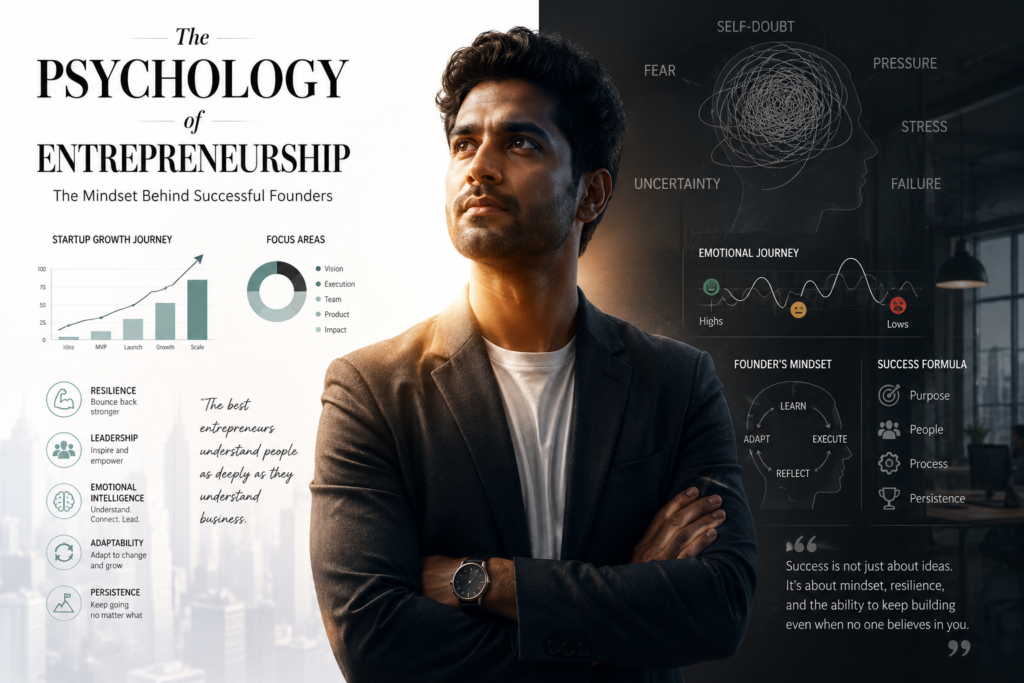
Explaining What Makes Entrepreneurship Unique
Employment in the traditional sense typically provides:
- A steady stream of revenue
- Identified and defined obligations
- Support from the organisation
- Structured career pathways
The opportunities that come with becoming an entrepreneur are really unique.
Founders are confronted with:
- A lack of financial certainty
- Making decisions on a consistent basis
- Direct responsibility for oneself
- The dangers of the market
- Competitive pressure
- Emotional tension
In contrast to employees, entrepreneurs frequently bear the complete responsibility for their own success or failure.
Because of this obligation, there are specific psychological requirements.
Having an Entrepreneurial Frame of Mind
Certain psychological characteristics are frequently shared by successful business owners.
Although the presence of these traits does not necessarily ensure success, they are typically observed in founders who achieve high levels of success.
Confidence and Optimism
Entrepreneurs frequently have the belief that they can create opportunities in areas where others do not see any.
Optimism assists founders to:
- Take chances
- Get past challenges
- Inspire teams
- Maintain motivation
It is possible for entrepreneurship to become overwhelming if optimism is lacking.
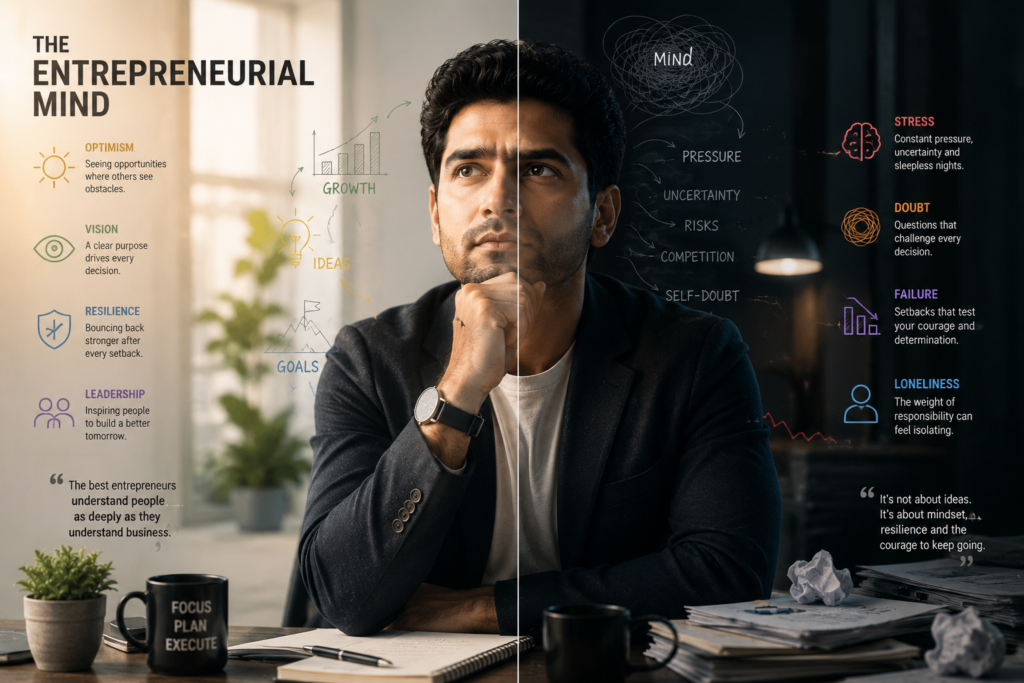
Capacity for Resilience
When it comes to entrepreneurship, failure is typical.
- Products are not successful.
- Investors do not accept pitches.
- Consumers leave.
- Markets shift.
Entrepreneurs who are resilient are able to bounce back from failures and keep pushing forward.
One of the most crucial traits that an entrepreneur can cultivate is the ability to bounce back from setbacks.
“Success is not final, failure is not fatal: it is the courage to continue that counts.”
Winston Churchill’s observation reflects why resilience remains one of the most important entrepreneurial traits.
Ability to Adapt
The market is always changing.
- Customer needs evolve.
- Technology advances rapidly.
- Industries transform.
Founders who are successful are able to modify their plans without losing sight of their vision.
In many cases, survival is determined by adaptability.
Curiosity and Interest
Learners who never stop learning are entrepreneurs.
They are actively looking for:
- Innovative concepts
- Superior solutions
- Market opportunities
- Customer insights
Innovation is driven by curiosity.
The Fear of Failing
The majority of business owners are affected by fear.
Common fears include:
- Financial loss
- Business failure
- Public embarrassment
- Letting employees down
- Disappointing family members
- Making poor decisions
There are many successful business owners who constantly face fear.
The distinction lies in the fact that they take action despite uncertainty.
Failure is frequently seen as a component of the learning process rather than a permanent conclusion.

The Role of Taking Risks
The term “risk-taker” is frequently used to describe entrepreneurs.
On the other hand, the majority of successful entrepreneurs do not engage in reckless behaviour.
They opt to take calculated risks.
They assess:
- Potential rewards
- Possible consequences
- Available information
- Alternative possibilities
Comfort with ambiguity is a prerequisite for entrepreneurial endeavours.
Absolute certainty rarely exists.
Founders who take calculated risks often find themselves navigating investor expectations, fundraising challenges and growth opportunities. Our guide to startup fundraising in India explores how entrepreneurs can prepare for these challenges.
Self-Confidence and Self-Belief
Founders are frequently subjected to criticism.
- Customers reject products.
- Investors say no.
- Competitors appear stronger.
It is crucial to have self-belief in these situations.
Confidence helps entrepreneurs:
- Communicate their vision
- Build teams
- Raise capital
- Inspire customers
On the other hand, excessive confidence can become risky.
Founders who are most successful strike a balance between self-assurance and humility.
Many founders are motivated by solving meaningful problems and building businesses that create impact. Several of the startup ideas investors are most excited about in 2026 reflect this shift toward purpose-driven entrepreneurship.
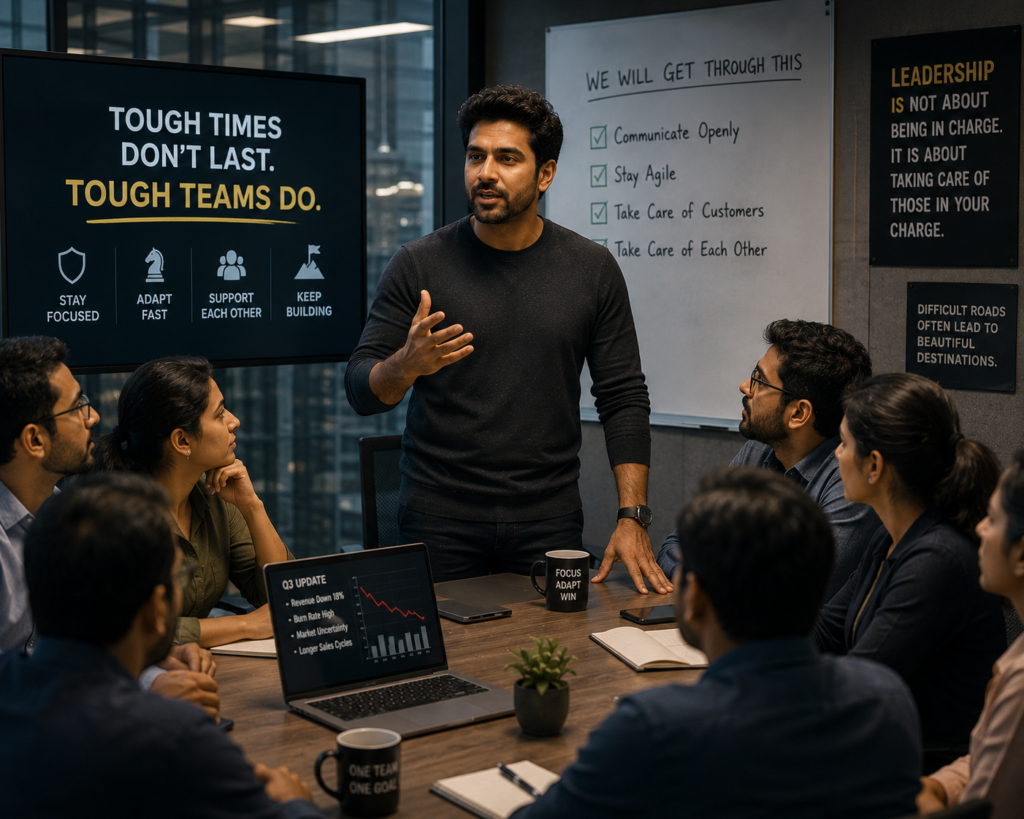
Decision-Making Under Pressure
Every day, entrepreneurs are faced with numerous decisions.
These choices often involve:
- Recruiting
- Pricing
- Investment
- Product development
- Marketing
- Expansion
Most decisions must be taken with incomplete information.
Because of this uncertainty, pressure is created.
Strong decision-makers:
- Gather information
- Assess risks
- Trust experience
- Act decisively
The expense of indecision can quickly add up.
Research from Harvard University continues highlighting the importance of resilience, leadership and emotional intelligence in high-performance environments.

The Emotional Rollercoaster of Entrepreneurship
Many founders describe entrepreneurship as an emotional journey.
One day may bring:
- New clients
- Investor interest
- Positive growth
The following day may involve:
- Financial problems
- Operational challenges
- Customer complaints
- Unexpected setbacks
Managing emotional highs and lows is a crucial skill.
During challenging times, emotionally stable entrepreneurs are better able to maintain their focus.

Founder Burnout and Stress
Many entrepreneurial ventures involve:
- Extended working hours
- Financial pressure
- Team management
- Customer demands
- Constant responsibility
Over time, these pressures can cause exhaustion and burnout.
Symptoms may include:
- Tiredness
- Anxiety
- Lower motivation
- Poor concentration
- Emotional exhaustion
Founder burnout is becoming increasingly widespread.
Within startup ecosystems, mental health has emerged as an important discussion.
The growing discussion around founder mental health reflects broader workplace trends highlighted by organizations such as The World Health Organization.
Experiencing Loneliness as an Entrepreneur
Many entrepreneurs go through periods of isolation.
- Employees may not fully understand leadership challenges.
- Family members may struggle to relate to business pressures.
- Friends with traditional careers may have different experiences.
Isolation can negatively impact mental health.
Establishing support networks is essential.
Examples include:
- Mentors
- Advisors
- Founder communities
- Peer groups
The journey of entrepreneurship does not have to be a solitary experience.

Emotional Intelligence
The ability to comprehend and control one’s emotions is what is meant by emotional intelligence.
Founders who possess a high level of emotional intelligence frequently:
- Communicate effectively
- Resolve disagreements
- Develop relationships
- Motivate teams
- Handle stress
Increasingly, emotional intelligence is becoming a prerequisite for leadership.
Employees frequently follow leaders who demonstrate empathy, understanding, and authenticity.
Studies on leadership and emotional intelligence conducted by Harvard Business Review continue emphasizing the importance of empathy and communication in leadership.
Motivation Beyond Financial Gain
Money alone is unlikely to provide long-term motivation.
Many entrepreneurs are motivated by:
- Purpose
- Impact
- Innovation
- Independence
- Problem-solving
- Personal growth
Having a purpose frequently makes difficult times easier to endure.
Businesses with meaningful missions often create stronger teams.
Characteristics of Successful Founders
Research and observations suggest that successful business owners frequently demonstrate:
- Perseverance
- Self-control
- Curiosity
- Optimism
- Adaptability
- Emotional control
They understand that difficulties are temporary.
They focus on progress rather than perfection.
Most importantly, they never stop learning.
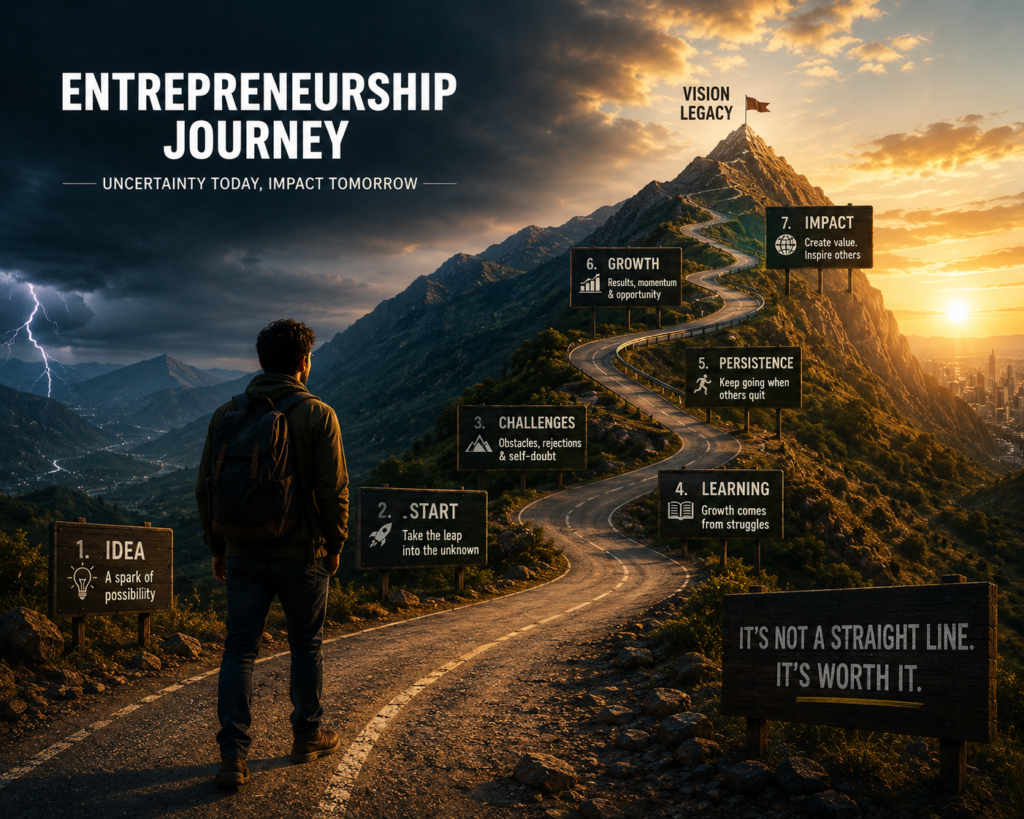
Imposter Syndrome Among Founders
Imposter syndrome affects many entrepreneurs.
They may question:
- Their abilities
- Their decisions
- Their qualifications
- Their leadership
Even founders who have achieved considerable success sometimes feel that they do not belong.
Recognising these emotions is extremely important.
Confidence often develops through experience and action.
“Doubt kills more dreams than failure ever will.”
Many founders experience self-doubt, yet confidence often develops through action and experience.
Developing Mental Strength
Mental fitness is necessary for entrepreneurial success.
In order to increase resilience, founders can:
- Maintain routines
- Exercise regularly
- Seek mentorship
- Build support systems
- Practice reflection
- Take breaks
Business performance is directly affected by mental health.
Taking care of personal well-being is not a weakness.
It is part of leadership.
“You cannot stop the waves, but you can learn to surf.”
Jon Kabat-Zinn’s insight highlights the importance of managing uncertainty rather than attempting to eliminate it.

Learning from Failure
Failure remains one of the most important teachers in entrepreneurship.
Many successful founders have experienced:
- Failed businesses
- Product mistakes
- Financial losses
- Investor rejection
Failure frequently results in:
- Experience
- Perspective
- Knowledge
- Improved judgement
The ability to learn from failures often determines future success.
Artificial Intelligence is increasingly becoming an important skill for entrepreneurs. Explore the AI tools every business should use in 2026.
The Entrepreneur of the Future
The next generation of entrepreneurs may require additional psychological skills.
Future founders may need:
- Adaptability
- AI literacy
- Continuous learning
- Emotional intelligence
- Digital skills
- Global thinking
Technology will continue to impact businesses.
Human qualities may become even more valuable.
Research from The World Economic Forum frequently highlights the importance of adaptability, continuous learning and digital skills.
Resilience, adaptability and long-term thinking are also common characteristics among founders building companies across India’s rapidly evolving innovation economy, from AI startups to manufacturing businesses.

Concluding Remarks
Starting a firm is only one aspect of what it means to be an entrepreneur.
Resilience, self-assurance, emotional intelligence, and flexibility are all components that are put to the test during this psychological journey.
It is not always the case that successful founders are born with the most brilliant ideas.
Individuals who continue to learn, adapt, and move forward in spite of uncertainty are frequently the ones who succeed.
Entrepreneurs can better prepare themselves for the realities of developing businesses if they have a better understanding of the psychology of entrepreneurship.
The human element of entrepreneurship remains constant, despite the fact that markets, technology, and industries are always evolving.
The ability to control anxiety, accept uncertainty, develop resilience, and maintain purpose may ultimately determine long-term success.
When all is said and done, being an entrepreneur is not simply about establishing businesses.
Building a mindset that is capable of building those organisations is the true objective.
“The mind is everything. What you think you become.”
The entrepreneurial journey is ultimately shaped not only by strategy and capital but also by mindset and mental resilience.