
For years, whenever India and exports were mentioned in the same sentence, one industry immediately came to mind: software. And understandably so. India’s information technology industry changed the way the world looked at the country, creating a global delivery model that allowed some of the world’s largest corporations to access Indian technology talent at scale.
From Bengaluru and Hyderabad to Pune, Chennai and Gurugram, an entire economic ecosystem was built around a simple but powerful idea: India could serve the world from India. Indian technology companies built global businesses, created millions of jobs and demonstrated that sophisticated services could be delivered from India to virtually anywhere in the world.
Software and IT services remain one of India’s greatest economic success stories. They created globally recognised companies, strengthened the country’s export capabilities and established India as a formidable technology talent hub.
But perhaps that extraordinary success also created a blind spot.
India’s next export story will certainly include software. But it is unlikely to be only about software.
That could become one of the most important shifts in India’s economic journey over the next decade.
This opportunity is closely connected to the wider global supply chain reset and India’s growing manufacturing opportunity, as multinational companies rethink sourcing concentration and production resilience.
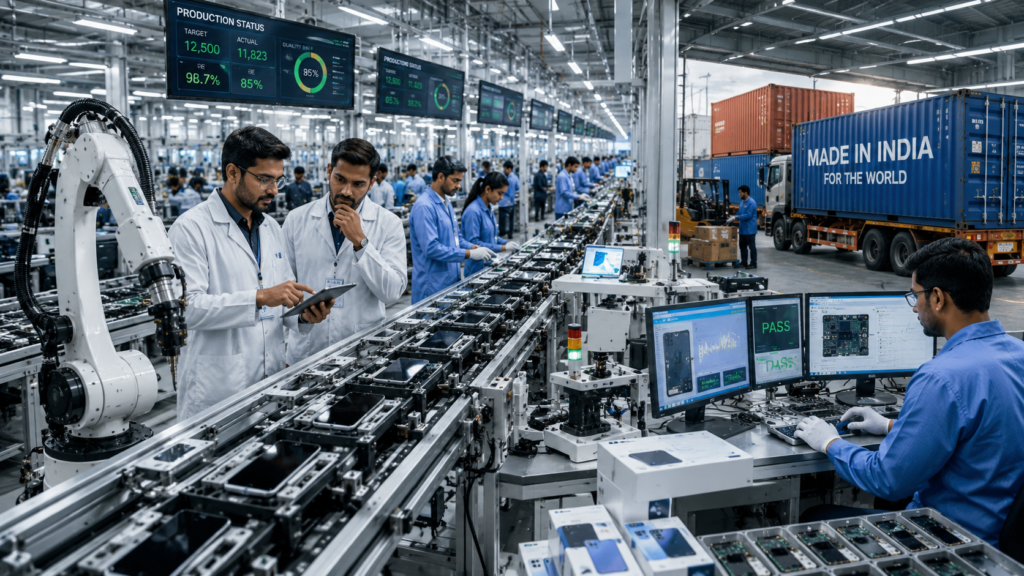
India Has Already Proved It Can Sell to the World
There was a time when many Indian businesses approached international markets with considerable hesitation. Exporting seemed complicated, foreign buyers appeared difficult to reach and international quality standards felt intimidating. Global supply chains were dominated by companies from China, Japan, South Korea, Europe and the United States.
For an Indian entrepreneur, the domestic market often appeared far more attractive. Why spend years trying to understand a foreign market when India itself offered more than a billion potential consumers?
That thinking made sense for a long time. But it is beginning to change.
India’s export ecosystem has expanded considerably, and the composition of what the country can sell to the world is evolving. The interesting part is not simply that India exports more; it is what India is increasingly capable of exporting.
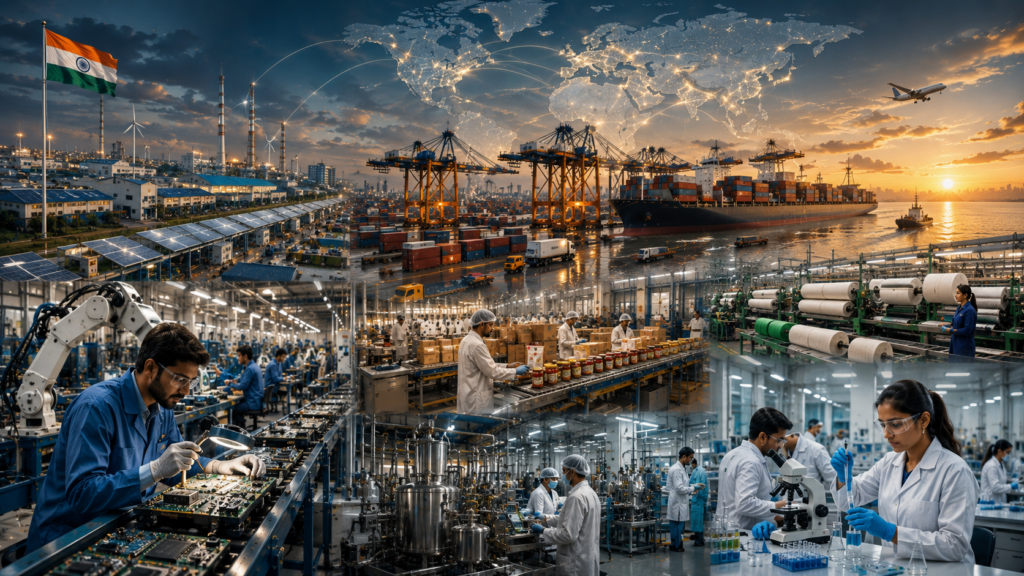
The country is no longer associated only with textiles, gems, agricultural commodities or low-cost production. Indian businesses are increasingly participating in sophisticated global value chains involving electronics, pharmaceutical products, engineering equipment and specialised components.
The world is not simply buying Indian labour anymore. Increasingly, it is buying Indian capability.
The growing China+1 strategy is creating a major manufacturing opportunity for India, although execution, infrastructure and global competitiveness will ultimately determine how much of this shift the country captures.
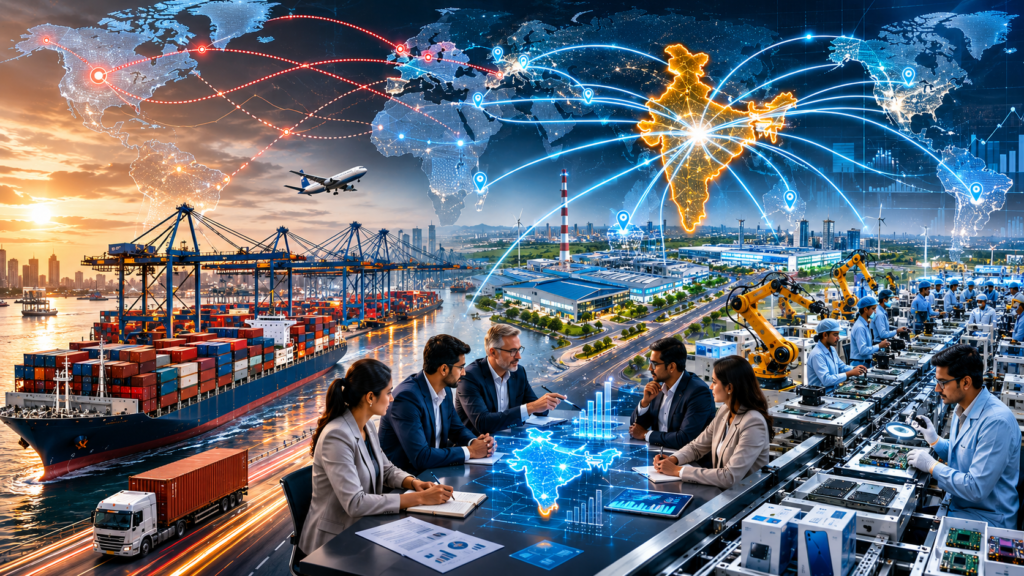
Electronics Show How Quickly India’s Export Story Can Change
Perhaps few industries demonstrate India’s changing export opportunity as clearly as electronics.
Not very long ago, India was primarily viewed as a massive consumer market for electronic products. Millions of mobile phones were sold across the country, but a significant part of the manufacturing value sat outside India.
Today, that picture is changing rapidly. Electronics manufacturing has expanded, and mobile phone exports have become one of the most visible examples of India’s growing manufacturing ambitions.
The significance of this shift is easy to underestimate. India did not invent the smartphone category, nor did global demand for smartphones suddenly emerge. What changed was India’s position in the value chain.
The scale of this transformation is visible in official government data, with the Government of India highlighting the rapid growth of electronics production and mobile phone exports over the past decade.
India’s electronics growth also forms part of the broader Make in India transformation reshaping manufacturing across electronics, defence, semiconductors and other strategic sectors.
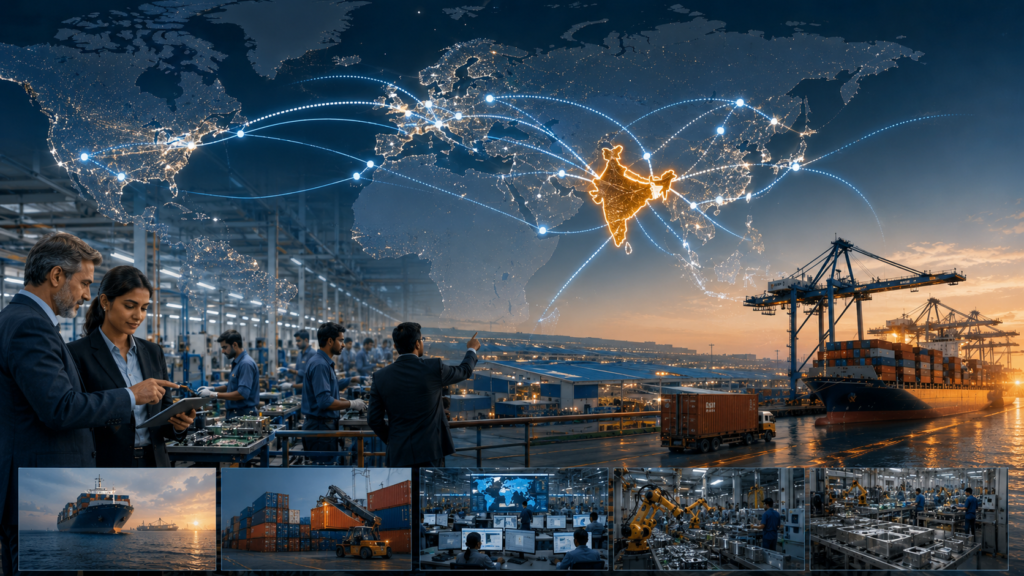
The World Is Rethinking Where Things Are Made
For decades, globalisation followed a fairly predictable formula. Companies searched for efficient manufacturing locations, concentrated production in highly competitive regions and built supply chains designed primarily around cost and speed.
As long as those systems worked, there was little incentive to change them.
Then came a series of disruptions. The pandemic exposed the vulnerability of highly concentrated supply chains, geopolitical tensions increased, shipping routes came under pressure and trade relationships became more complicated. Businesses suddenly discovered the risks of depending too heavily on a limited number of suppliers or manufacturing locations.
Supply chain resilience quickly became a boardroom priority. Global companies began asking whether they could diversify suppliers, establish additional manufacturing locations and reduce dependence on individual geographies.
This global supply chain reset creates an opportunity for India, but there is an important reality Indian businesses must recognise: India does not automatically win simply because companies want alternatives.
Several countries are competing aggressively for the same manufacturing investment and global supply contracts. India enters this competition with significant advantages, including:
- A large and increasingly skilled workforce
- A massive domestic market
- Strong engineering talent
- Improving physical infrastructure
- Expanding digital capabilities
- A growing network of industrial clusters
- An increasingly ambitious entrepreneurial ecosystem
The opportunity is real. The challenge, as always, is execution.
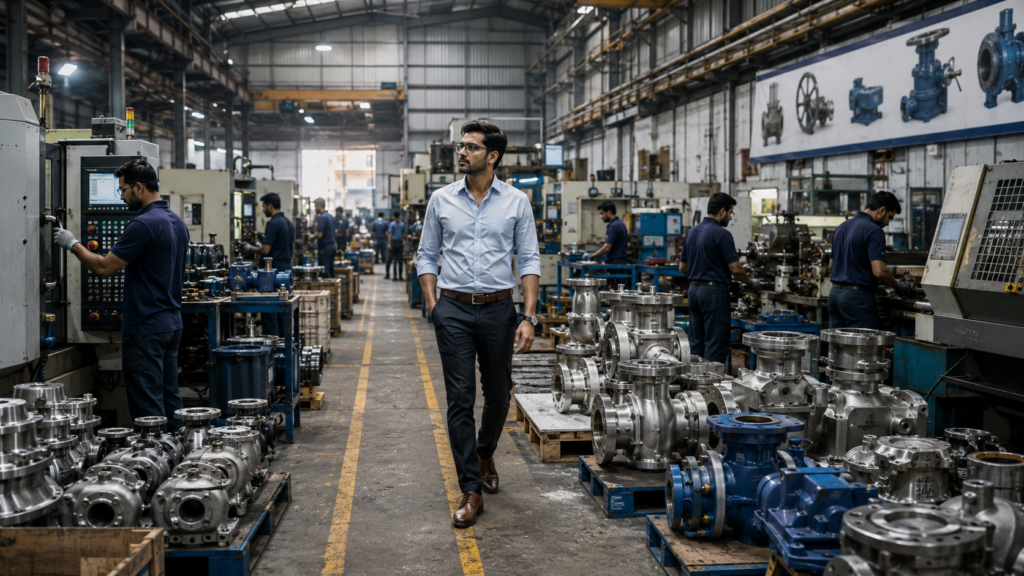
India’s Engineering Businesses May Be Sitting on a Global Opportunity
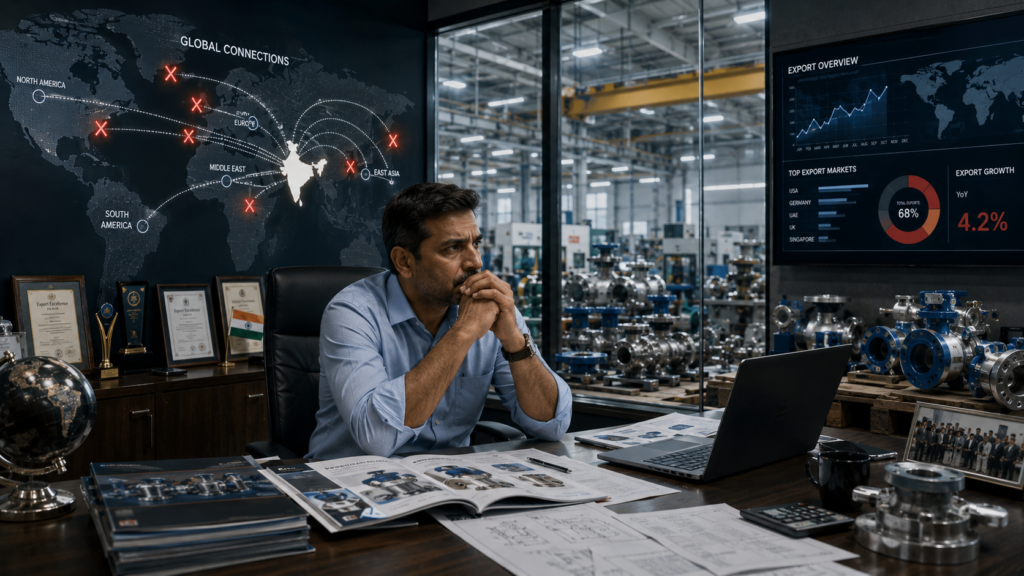
Visit an industrial cluster in India and you may discover an entirely different side of the economy. There are companies manufacturing highly specialised products that most ordinary consumers will never see.
These businesses produce precision components, industrial pumps, electrical equipment, machine parts, fasteners, valves, automotive components, packaging machinery and speciality materials. Many have spent decades developing deep technical expertise and understanding their product categories.
The problem is not always product capability. Often, it is global market access.
A manufacturer in Rajkot may have the capability to serve customers in Africa or the Middle East. An engineering company in Coimbatore may manufacture equipment relevant to European buyers, while an auto-component supplier in Pune may possess the technical capabilities required to participate in international supply chains.
But being able to manufacture a product and being able to sell it internationally are two completely different skills.
This may be one of India’s biggest hidden export gaps: thousands of Indian businesses know how to make things, but far fewer know how to sell those things to the world.
Recent trade data further shows the breadth of India’s merchandise opportunity, with electronics, engineering goods and pharmaceuticals among the sectors contributing to export growth.
India May Have a Global Sales Problem, Not a Product Problem
Indian entrepreneurs often spend enormous amounts of time improving their products. They invest in machinery, upgrade production lines, improve quality, hire engineers, expand manufacturing capacity and obtain industry certifications.
All of these investments matter. However, international growth requires another capability entirely: global sales.
This is where many Indian MSMEs struggle.
A business may manufacture an excellent product but have almost no international sales infrastructure. Common challenges include:
- The founder personally handling every important enquiry
- An outdated website that fails to communicate capabilities
- Poorly designed or confusing product catalogues
- Limited international digital visibility
- Generic bulk emails sent to overseas buyers
- Weak follow-up processes
- No structured global sales strategy
Meanwhile, a foreign buyer researching potential suppliers has no easy way to understand why a particular Indian manufacturer deserves attention.
The export opportunity is not always lost on the factory floor. Sometimes, it is lost in the inbox.
India’s Food Export Opportunity Is Still Underestimated
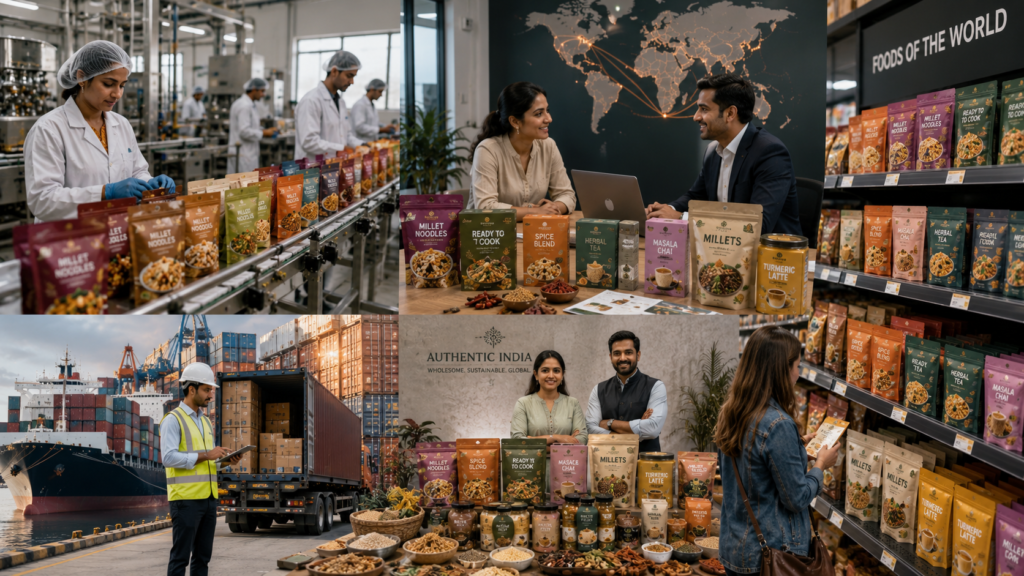
India possesses one of the world’s richest and most diverse food cultures. Yet only a small fraction of that diversity has been converted into globally scaled food brands.
Rice and spices remain important exports, but the opportunity extends much further. Global consumers are increasingly comfortable experimenting with international flavours, while the Indian diaspora provides many businesses with a natural entry point into overseas markets.
Potential export categories could include:
- Regional Indian snacks
- Millet-based foods
- Ready-to-cook products
- Frozen Indian meals
- Traditional beverages
- Indian spice blends
- Health-focused foods using Indian ingredients
- Premium tea and coffee
- Processed fruit products
- Regional sauces and condiments
But there is an important distinction between exporting food and exporting food brands.
A commodity competes heavily on price. A brand can compete on quality, trust, identity, convenience and experience.
India has spent decades exporting products. The next opportunity may be to export Indian brands.
Small Indian Cities Could Become Export Hubs
One of the most exciting aspects of India’s export opportunity is that it does not have to remain concentrated in Mumbai, Delhi, Bengaluru or other major cities.
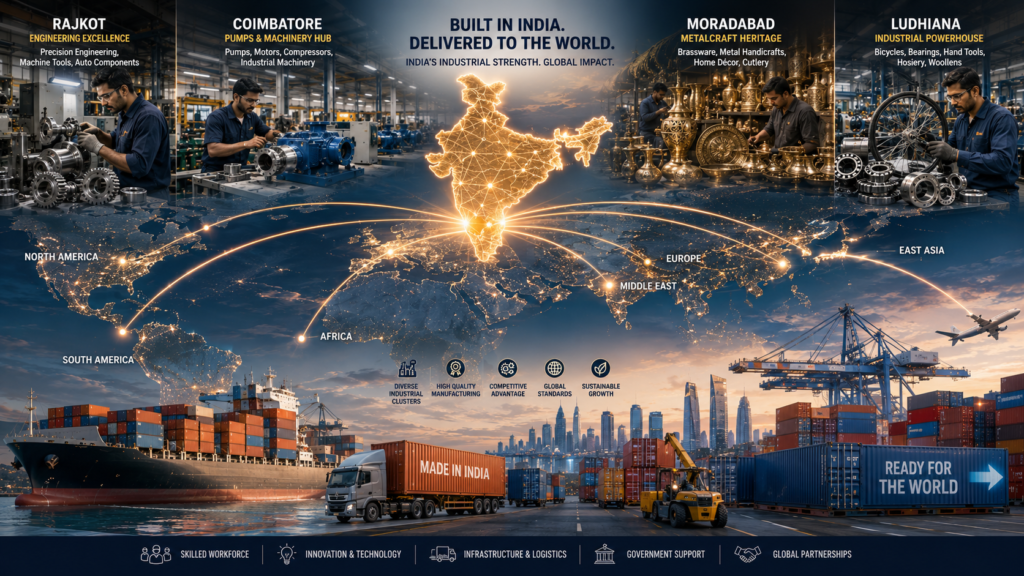
India’s manufacturing capabilities are deeply distributed. Moradabad is known for metalware, Tiruppur has built a powerful textile ecosystem, Surat is globally recognised for diamonds and textiles, while Rajkot has significant engineering capabilities.
Coimbatore has a strong manufacturing base. Ludhiana is known for bicycles, auto components and hosiery. Agra has a long-established footwear industry, and Jalandhar has developed expertise in sports goods.
Across India, hundreds of districts possess specialised skills, products and manufacturing traditions. In many cases, these capabilities have been built over generations.
What has changed is access to information.
The idea of building export capability beyond major metropolitan centres also aligns with the Districts as Export Hubs initiative, which seeks to develop district-level export potential and strengthen local export ecosystems.
Export Data Could Become a Competitive Advantage
Ask an Indian business owner where they want to export and the answer often includes familiar markets such as the United States, United Kingdom, Europe or the UAE.
But why?
Sometimes, the answer is simply because those are the markets the entrepreneur knows.
That is familiarity. It is not necessarily strategy.
A serious export strategy should begin by answering questions such as:
- Which countries import my product category?
- Which markets are growing fastest?
- Where is India already competitive?
- Which countries depend heavily on imports?
- Who currently supplies those markets?
- Are buyers searching for alternative sourcing locations?
- What tariffs, standards or trade agreements affect the opportunity?
The answers may lead an entrepreneur towards markets they had never previously considered. The opportunity could be in Africa, Latin America, Eastern Europe, Central Asia or a smaller Middle Eastern economy.
The world is an enormous marketplace. Indian exporters need to stop treating a handful of familiar destinations as if they represent all of it.
India’s wider trade and export policy ecosystem is coordinated through the Department of Commerce under the Ministry of Commerce and Industry.
Government Platforms Exist, but Awareness Remains the Problem
India has built export promotion councils, trade intelligence systems, government platforms and institutional support mechanisms for exporters. Yet many entrepreneurs remain unaware of what is available or do not know how to use these resources effectively.
A business owner may spend lakhs on a generic market research report while ignoring publicly available trade data. A manufacturer may complain about not finding international buyers without ever seriously engaging with the relevant export promotion council.
Similarly, a small company may remain completely unaware of government schemes or market-access programmes relevant to its industry.
This is a recurring problem across India’s business ecosystem. Opportunity exists, information exists and support structures exist, but awareness remains fragmented.
For entrepreneurs, learning how to navigate India’s export ecosystem could itself become a competitive advantage.
Indian exporters can also access trade policy, export procedures and support initiatives through the Directorate General of Foreign Trade, which administers key elements of India’s foreign trade ecosystem.
India Must Move From Cost Advantage to Capability Advantage
For years, one of India’s strongest global selling propositions was cost. Indian talent was affordable, Indian services offered value and Indian manufacturing could be price competitive.
Cost will continue to matter, but competing primarily on price is dangerous. There will almost always be another country willing to manufacture something more cheaply.
India’s long-term export advantage must increasingly come from capability, including:
- Better engineering
- Consistent quality
- Reliable delivery
- Stronger design
- Faster innovation
- Digital integration
- Specialised knowledge
- Resilient supply chains
- Trusted Indian brands
The question should no longer simply be, “Can India make this more cheaply?”
The better question is, “Can India become one of the best places in the world to make this?”
That represents a very different ambition.
India’s total exports during FY2025–26 were estimated at US$860.09 billion, with merchandise exports estimated at US$441.78 billion and services exports at US$418.31 billion.— Government of India trade data
This shift towards capability is already visible in the rise of smart factories and Industry 4.0 technologies across Indian manufacturing, where AI, automation and connected systems are changing how factories operate.
AI Could Give Smaller Indian Exporters an Unexpected Advantage
Artificial Intelligence may quietly change the export game for Indian MSMEs.
Imagine a small engineering company trying to evaluate ten international markets. Traditionally, serious research could require expensive consultants and months of work.
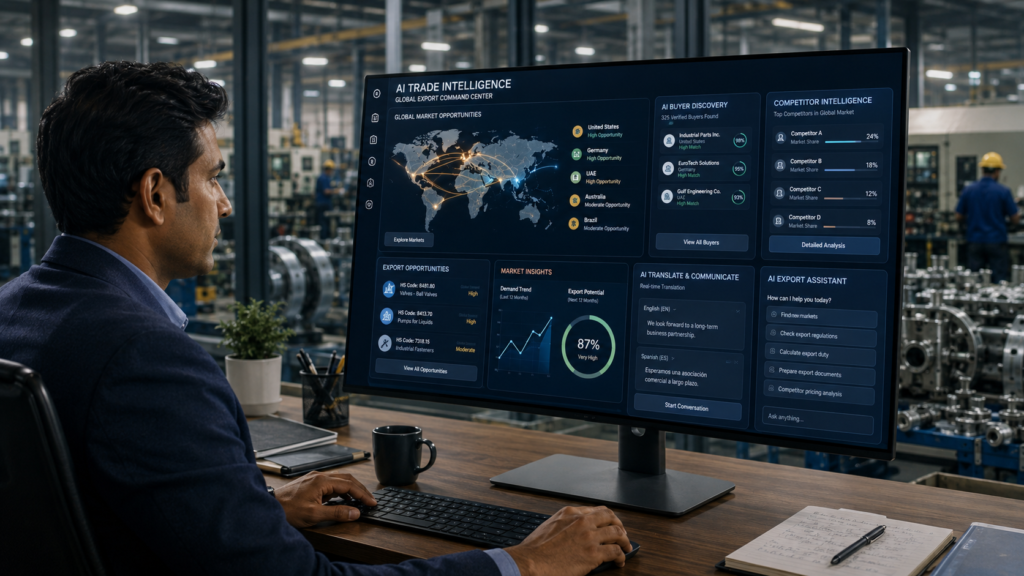
Today, AI tools can potentially help businesses research overseas markets, study competitors, translate product information and improve international communication.
Smaller exporters could use AI to:
- Research overseas markets
- Identify potential buyer categories
- Analyse competitor positioning
- Create professional product content
- Translate catalogues and communication
- Personalise sales outreach
- Analyse international enquiries
- Support lead-generation processes
AI will not replace genuine export expertise. It cannot remove regulatory requirements, quality expectations or the importance of relationships.
But it can reduce the information disadvantage that smaller businesses have historically faced. For an Indian MSME operating with limited resources, that could be significant.
The ability of technology to create leverage for smaller businesses also reflects the broader rise of AI-powered entrepreneurship and leaner business models in India.
Exporting Is No Longer Only for India’s Largest Companies
There is still a perception that exporting requires international offices, large teams and enormous capital.
In some industries, those capabilities may be necessary. But the barriers are changing.
A specialised manufacturer can begin with one international customer. An Indian food company can test a diaspora market, an engineering business can work through an overseas distributor, while a design-led consumer brand can explore cross-border commerce.
The first export order does not need to transform a business overnight.
It simply needs to prove one important thing: someone outside India is willing to pay for what you have built.
From there, the learning begins.
The export opportunity is also part of a much larger economic transformation, with AI, manufacturing, infrastructure and entrepreneurship shaping India’s next phase of economic growth.
The Next Indian Export Champions May Be Companies We Have Never Heard Of
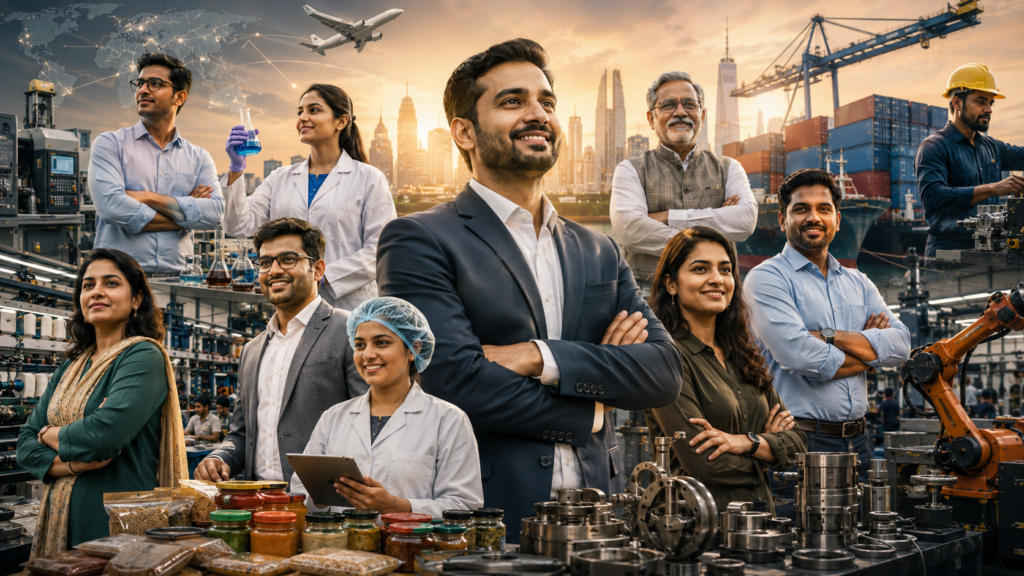
When we discuss India’s global businesses, the conversation usually revolves around familiar corporate names. But the next generation of Indian export champions may emerge from companies that currently receive almost no media attention.
It could be a precision component manufacturer operating from an industrial estate, a speciality food company in a small city or a chemical business run by the second generation of a family.
Perhaps it will be an engineering startup solving a highly specific industrial problem, a textile company developing sustainable materials or a specialised machinery manufacturer serving a narrow global industry.
Most Indians may never know their names.
Yet these businesses could build hundreds or even thousands of crores in global revenue.
That is one of the most fascinating things about exports: you do not need every Indian consumer to know your company. You need the right customers around the world to trust it.
