
Software-as-a-Service (SaaS) has emerged as one of the most transformative segments of the global technology industry. By delivering software through cloud-based platforms rather than traditional on-premise installations, SaaS allows businesses to access powerful applications through the internet without heavy infrastructure investment.
This growth is closely linked to broader shifts in the digital economy of India, where cloud adoption and digital transformation are accelerating.
Over the past decade, SaaS has fundamentally changed how organisations deploy software, enabling faster adoption, lower costs, and scalable solutions for businesses of all sizes.
India has become one of the fastest-growing SaaS ecosystems in the world, with startups building products used by companies across the United States, Europe, and Asia. Today, the country hosts more than 1,000 SaaS companies, many of which sell their products globally from India.
From customer relationship management platforms and enterprise productivity tools to cybersecurity and AI-driven analytics software, Indian SaaS companies are increasingly becoming global technology players.
Globally, the SaaS market continues to expand rapidly. Organizations like the World Economic Forum highlight that cloud-based platforms are transforming how businesses operate and scale.
What is SaaS?
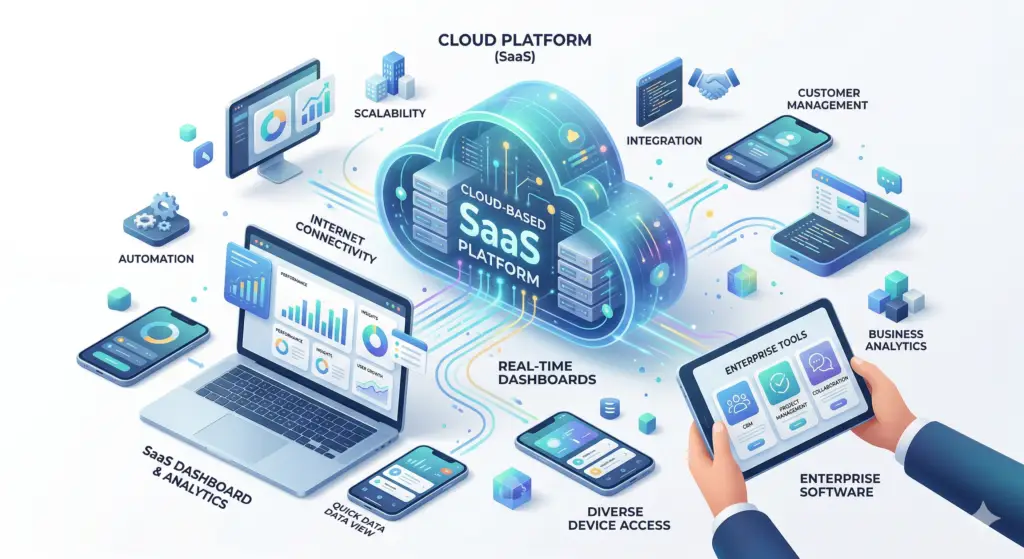
Software-as-a-Service refers to a cloud-based software delivery model in which applications are hosted online and accessed through web browsers or APIs.
Unlike traditional software that requires installation on local computers or servers, SaaS applications operate on subscription models and are maintained by the software provider.
Key characteristics of SaaS platforms include:
• Cloud-based delivery
• Subscription pricing models
• Automatic updates and maintenance
• Scalability for businesses of all sizes
• Accessibility from any internet-connected device
Examples of SaaS applications include:
• Customer relationship management tools
• project management software
• HR and payroll platforms
• marketing automation systems
• cybersecurity platforms
The SaaS model has gained widespread adoption because it reduces IT infrastructure costs and enables companies to deploy software much faster.
More importantly, the SaaS business model enables scalability and recurring revenue. Insights from McKinsey & Company suggest that subscription-based models are key to sustainable growth.
Global SaaS Market Size
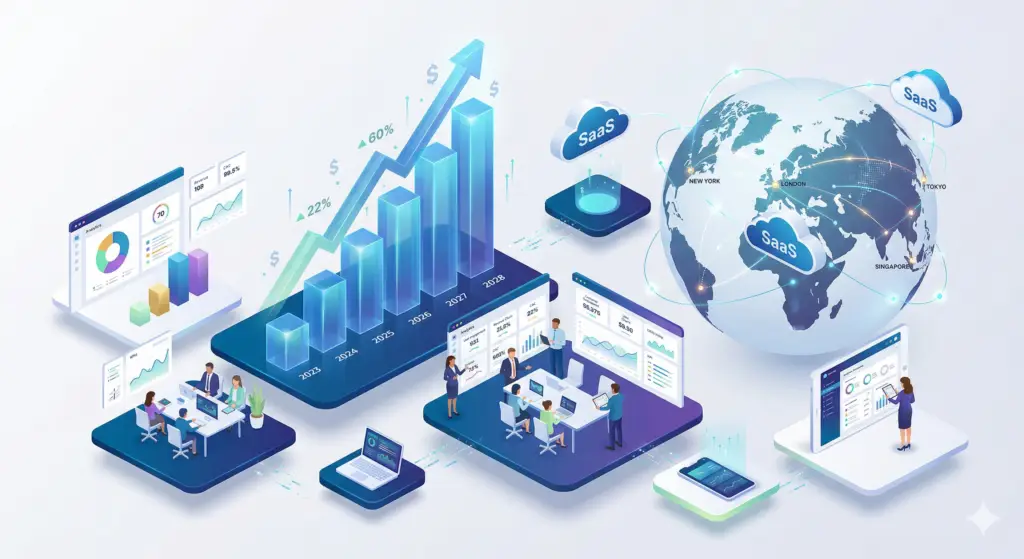
The global SaaS market has experienced explosive growth over the past decade as organisations increasingly migrate their operations to the cloud.
Industry estimates highlight the scale of this transformation:
- The global SaaS market is expected to exceed $300 billion by 2025.
- It could grow to over $1.1 trillion by the early 2030s, driven by digital transformation and cloud adoption.
Several factors are accelerating global SaaS adoption:
• increasing cloud infrastructure adoption
• remote and hybrid work environments
• enterprise digital transformation initiatives
• AI integration into business software
SaaS platforms are now widely used across industries including finance, healthcare, retail, logistics, and education.
For many organisations, SaaS applications have become the primary software infrastructure powering their operations.
At the same time, this mirrors trends seen in AI sector growth in India, where technology-led innovation is gaining global traction.
The Rise of India’s SaaS Ecosystem
India has emerged as one of the most exciting SaaS innovation hubs globally.
In India, the technology sector is witnessing strong momentum. According to the India Brand Equity Foundation (IBEF), digital adoption and global demand are driving growth across software services.
Several factors have contributed to the rapid growth of the Indian SaaS industry:
Large Engineering Talent Pool
India produces hundreds of thousands of software engineers every year, providing SaaS startups with access to a deep pool of technical talent.
Global Customer Base
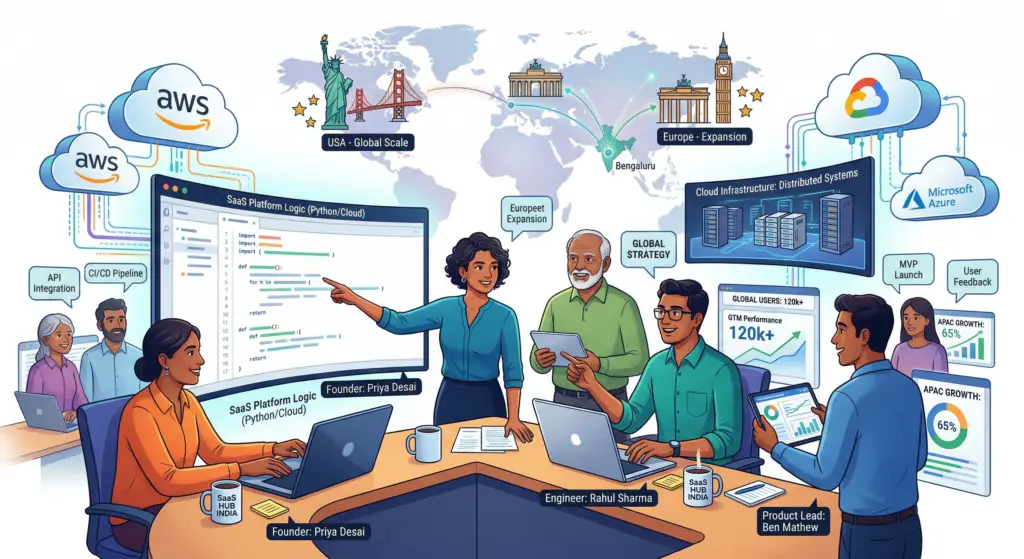
Many Indian SaaS startups build products primarily for international markets, particularly the United States and Europe.
This global-first approach allows startups to generate revenue in stronger markets while operating with cost advantages in India.
Cloud Infrastructure Availability
The widespread availability of cloud platforms such as AWS, Google Cloud, and Microsoft Azure has significantly reduced the cost of building and scaling SaaS products.
Startup Ecosystem Growth
India is now the third-largest startup ecosystem in the world, with increasing venture capital investment flowing into enterprise technology companies.
In addition, SaaS startups are leveraging insights from go-to-market strategies to scale globally and acquire customers efficiently.
Market Size of the Indian SaaS Industry
India’s SaaS industry has grown rapidly in recent years and is expected to continue expanding over the next decade.
Key market indicators include:
- The Indian SaaS market generated roughly $7 billion in revenue in 2023.
- Industry revenues are expected to grow to over $62 billion by 2032, representing a compound annual growth rate of around 27%.
- The market could eventually exceed $100 billion by 2035 as enterprise adoption accelerates.
The Indian SaaS ecosystem has also achieved significant milestones:
• more than 1,000 SaaS startups operating in the country
• dozens of companies generating over $100 million in annual recurring revenue (ARR)
• strong investor interest and growing IPO pipelines
These indicators demonstrate that India is becoming a major contributor to the global SaaS economy.
This also aligns with evolving trends in startup funding, where sustainable growth and strong unit economics are becoming critical.
Key Growth Trends in the SaaS Industry
Several major technology and business trends are driving the expansion of SaaS globally and in India.
1. Cloud-First Digital Transformation
Businesses across industries are increasingly adopting cloud-based platforms for their operations.
Companies are replacing legacy software systems with modern SaaS platforms that offer:
• better scalability
• lower maintenance costs
• faster deployment
This shift toward cloud-first architecture has significantly accelerated SaaS adoption.
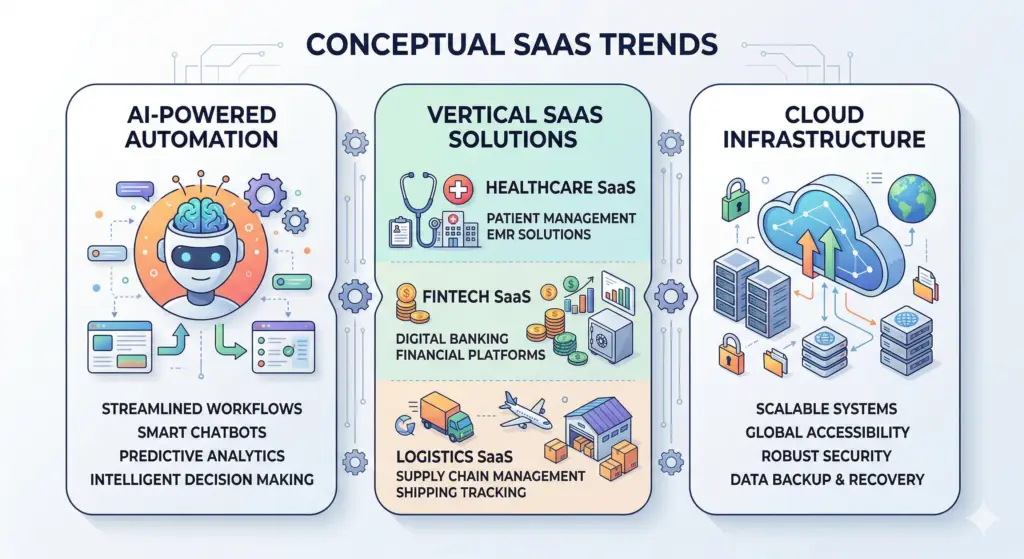
2. Rise of AI-Powered SaaS
Artificial Intelligence is becoming deeply integrated into SaaS platforms.
Modern SaaS tools now include features such as:
• predictive analytics
• AI-driven automation
• conversational interfaces
• intelligent workflow optimisation
AI-powered SaaS platforms are helping companies automate complex tasks and improve decision-making.
3. Growth of Vertical SaaS
Traditional SaaS platforms served broad horizontal functions such as CRM or project management.
However, a new category known as Vertical SaaS is gaining traction.
Vertical SaaS platforms are designed specifically for particular industries such as:
• healthcare
• real estate
• logistics
• financial services
• education
These specialised solutions provide deeper functionality tailored to industry-specific needs.
4. Global Expansion of Indian SaaS Companies
Many Indian SaaS companies operate globally from day one.
This strategy allows them to:
• target larger markets
• generate higher revenue
• scale internationally
Several Indian SaaS companies now serve thousands of international customers.
This transformation is supported by initiatives like Digital India, which provide a strong foundation for cloud adoption and digital innovation.
The Future of the SaaS Industry in India
The next decade could be transformative for the Indian SaaS ecosystem.
Industry analysts believe India could capture 4–6% of the global SaaS market, generating annual revenues of $50–70 billion by 2030.
Several factors will shape the future of the sector:
• increasing global demand for enterprise software
• continued growth of cloud infrastructure
• integration of artificial intelligence into SaaS platforms
• expansion of India’s startup ecosystem
India’s strong engineering talent, combined with its cost advantages and entrepreneurial ecosystem, positions the country to become a global SaaS powerhouse.
Looking ahead, institutions like the World Bank highlight that digital platforms and SaaS solutions will continue to drive economic growth and innovation globally.
Final Thoughts
Software-as-a-Service has fundamentally transformed how businesses use technology. By shifting software delivery to the cloud, SaaS platforms enable organisations to scale faster, reduce costs, and adopt new technologies more efficiently.
India’s SaaS ecosystem is still evolving, but its growth trajectory is clear. With thousands of startups, a rapidly expanding global customer base, and increasing venture capital investment, India is poised to become one of the most influential SaaS innovation hubs in the world.
As digital transformation accelerates across industries, SaaS companies will play a critical role in shaping the future of enterprise technology.
