The US has long been seen by Indian exporters as one of their most crucial markets for growth.
America’s demand has been a significant driver behind some of India’s top enterprises and export industries, from pharmaceuticals and engineering items to textiles, electronics and IT services.
But there is a difficulty.
Donald Trump has never been a big believer in free trade.
With tariffs making a comeback to the center stage of American economic policy, Indian businesses may have to face an uncomfortable reality: India may be strategically vital to the United States, but that doesn’t always mean Indian exporters will get a free pass.
The concern is not merely that some things get more expensive in America.
The major concern is that tariffs might alter supply chains, pressure margins, complicate investment decisions and make Indian companies compete in a far more politically heated global trading climate.
This might be a threat and opportunity for the Indian exporters.
But it could be a very costly mistake to assume that India will automatically benefit from Trump’s trade war.
“The United States and India commit to provide each other preferential market access in sectors of respective interest on a sustained basis.”United States-India Joint Statement
Trump, Tariffs and Trouble: Here’s Why India’s Exporters Should Be Nervous
The United States has long been one of the most important markets for Indian exporters.
Demand from America has been good for Indian pharmaceuticals, engineering items, textiles, jewelry, chemicals, electronics and technological services. The US is not merely another market for export for many companies. It is the market that justifies the building of another factory, the hiring of another thousand personnel and the investment in the next stage of growth.
Building businesses that can withstand decades of changing economic conditions is a different challenge altogether, as the remarkable journey behind The Reliance Story demonstrates.
That is exactly why Donald Trump’s return to aggressive tariff politics should worry Indian exporters.
Not necessarily to panic them.
But scare them? Of course.
The issue is more than a 10% tariff here or an 18% reciprocal charge there. The bigger problem is uncertainty. US tariff policy toward India and other trading partners has regularly oscillated until 2026, while India and the US have resumed negotiations on a broader trade deal. Recent US policies have also exposed very diverse sectors to very varied degrees.
The latest United States-India Joint Statement on trade provides important context on the evolving tariff framework and sector-specific treatment.
For an exporter seeking to plan investments five years out, such uncertainty can be almost as detrimental as the levy itself.
And here’s the uncomfortable truth: India may be America’s strategic partner, but Trump has shown time and again that strategic alliances don’t necessarily come with free trade benefits.
The America Problem: India Is More Dependent Than It Wants To Be
India has been talking of diversifying its exports for years.
However, the United States is India’s largest and most important export market, taking over a fifth of Indian exports, according to recent reports. That dependence has continued despite attempts to expand other markets.
According to the Office of the United States Trade Representative’s India trade summary, bilateral goods and services trade between the two countries remains substantial.
That leaves a gap.
If a corporation is heavily selling into Europe, the Middle East and Southeast Asia, a tariff shock in America is painful but workable.
But consider:
- A textile maker whose biggest customers are American stores.
- An engineering company that sells parts to US manufacturers.
- A gems and jewelry exporter who has an American customer.
In a hurry, a tariff might become a margin issue.
The American importer has three options:
- Take the extra fee.
- Pass the additional price along to consumers.
- Request a price reduction from the Indian supplier.
Guess which is the one Indian exporters are most likely to hear first?
“Can you reduce your price?”
That is where Trump’s tariff politics stops being a Washington policy debate and becomes a boardroom crisis in Surat, Tiruppur, Mumbai or Ludhiana.
Not All Indian Exporters Are Equally Vulnerable
The good news: the effect is not uniform.
The Indian government stated a large portion of Indian exports were not covered by some higher levies and recent US actions exempted or treated some categories differently. For instance, the Section 301 measures introduced in July 2026 added a 10% levy on covered Indian imports, but the Indian government indicated that almost 45% of exports to the US continued to fall outside that specific tariff net.
The Government of India also provided an official update on the final US Section 301 measures affecting Indian imports.
But it doesn’t mean exporters can relax.
Price competitiveness is of paramount importance in labour-intensive sectors like textiles, apparel, jewelry, shrimp and others, which are particularly vulnerable. Even a small tariff may mean an order is placed with another country rather than India if the customer believes the alternative supplier can offer a cheaper landed cost.
This is especially problematic for smaller exporters.
A huge company can probably take a few points of margin pressure.
Small manufacturers frequently work on low margins, and cannot.
The Real Danger Isn’t Trump. It’s Uncertainty.
This is where the discussion gets more controversial.
Indian companies have spent years trying to figure out how to compete with China.
They know how to make a fight.
They are aware of currency swings.
They understand rising freight rates.
The problem for businesses is that they don’t know what the rules are going to be six months from now.
A corporation does not establish a new export-oriented factory on the basis of one strong quarter.
It invests on the basis of assumptions about future demand.
This challenge becomes even more significant when businesses need long-term capital to expand, a problem explored in our analysis of India’s scale-up capital problem.
What happens when those assumptions suddenly shift?
A new tariff can diminish the attractiveness of an investment.
A new exception can be beneficial to a competitor.
A political quarrel can turn into a trade fight overnight.
A trade pact can alter the economics of an entire industry.
That uncertainty makes it difficult to plan for the long run.
And Trump has made tariffs a bargaining chip.
“President Trump’s dealmaking is unlocking one of the largest economies in the world for American workers and producers.”Jamieson Greer, United States Trade Representative
The broader evolution of these policies can be tracked through the USTR’s Presidential Tariff Actions page, which documents the changing framework of US tariff measures.
Tariffs are no longer only about safeguarding American industries. They can also be used as instruments of diplomacy, political pressure and negotiation.
That should be a wake-up call for Indian exporters.

India Can’t Wait for China+1 To Save It
One of the largest changes in global business in recent years has been India’s advantage from companies’ wish to minimise their reliance on China.
They call it the China+1 strategy, and it has produced huge opportunities.
Manufacturers are looking for other locations for production.
Global supply chains are diversifying.
India has emerged as one of the major potential beneficiaries.
However, attracting global manufacturing and investment raises another important question: who ultimately owns the value being created? Read our analysis on why foreign investors often own a significant share of India’s startup upside.
But there is a dangerous assumption in that scenario.
It implies that corporations will immediately shift to India if they move out of China.
They might not.
- Vietnam is in the race.
- Mexico is in the contest.
- Indonesia is in the race.
- Bangladesh is in the race.
- Eastern Europe is in the contest.
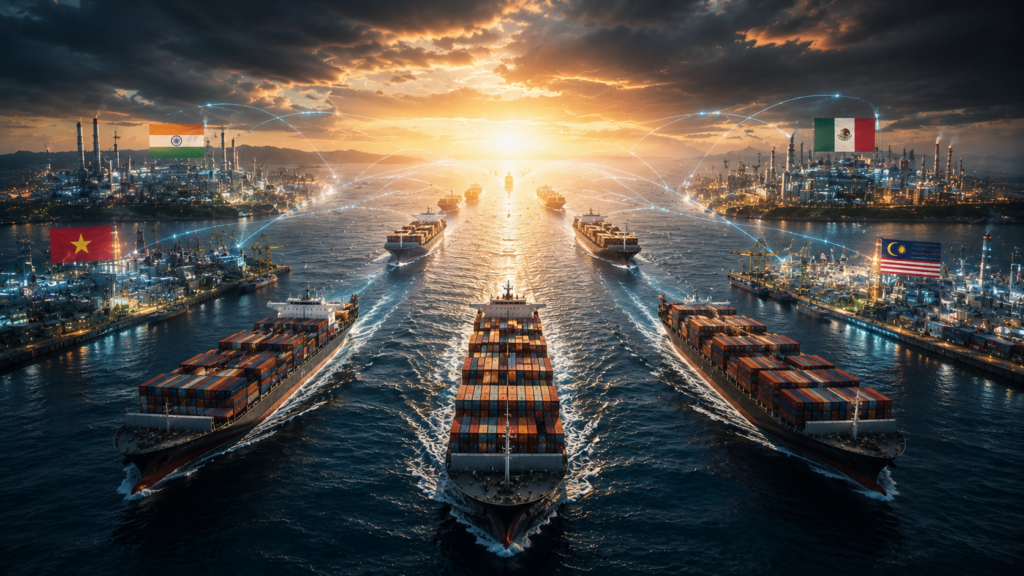
And increasingly, corporations are evaluating numerous locations rather than just switching out China for one new country.
This could create a strange situation with Trump’s tariffs.
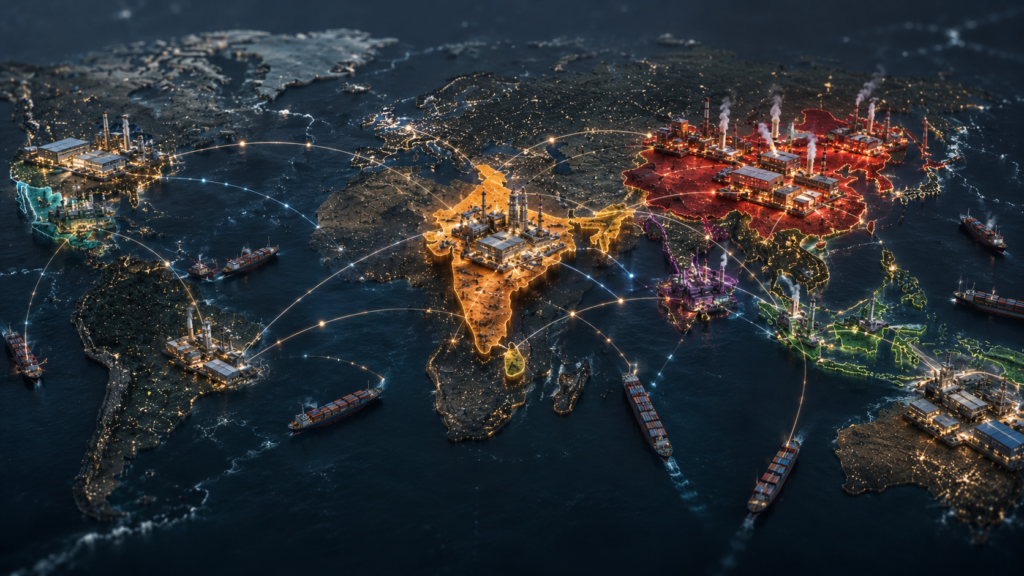
India might be a winner as tariffs could increase the price of Chinese goods.
At the same time, India itself may miss out if its own exports become pricier or more uncertain.
This indicates that China+1 is not India’s due.
India still has to deserve it.
The Textile Industry May Be a Canary in the Coal Mine
The pressure is already causing some Indian enterprises to reconsider their dependence on the US market.
For example, Raymond Lifestyle has indicated it wants to boost its footprint in European markets as part of a strategy to lessen dependence on the United States given changing trade conditions.
Raymond Lifestyle’s strategy to increase its exposure to Europe while reducing its reliance on the US market offers a real-world example of how Indian exporters are responding to changing trade conditions, as reported by Reuters.
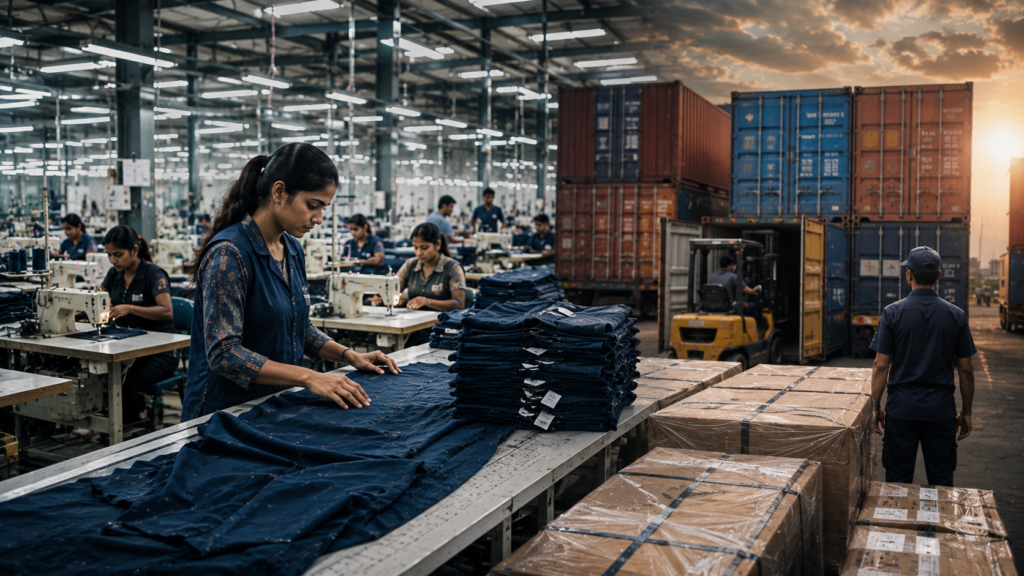
That might be a broader trend.
For decades, exporters have been advised to focus on broad, dependable foreign markets.
America was supposed to be one of them.
But if trade policy becomes increasingly unpredictable, Indian enterprises may have to reassess what diversification means.
The future may include:
- More Europe.
- More business in the Middle East.
- Expansion in Africa.
- Closer trade ties with emerging markets.
- Reduced dependence on any one export market.
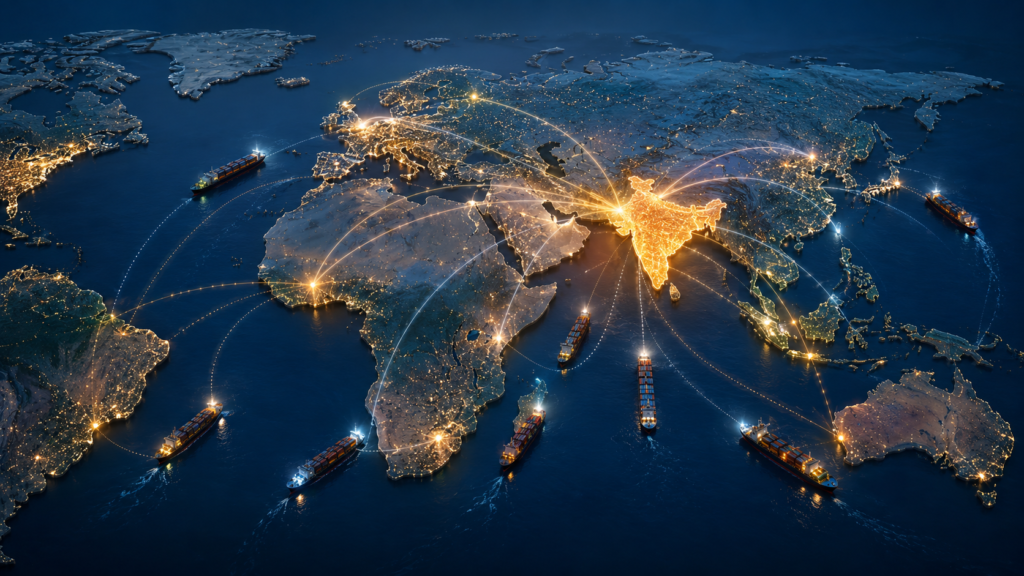
This is not necessarily negative news for India.
In reality, it could make Indian exporters more resilient.
But it will need corporations to adjust their tactics.
Other Indian apparel exporters are also reconsidering market and manufacturing strategies as changing US trade policies and global supply-chain disruptions reshape the economics of exports, according to recent reporting by Reuters.
The Bigger Question: Is India Generating Sufficient Value?
There is another difficult lesson here.
The more differentiated your product, the more pricing power you have.
If you’re exporting a commodity that can be easily sourced from five other nations, a tariff can kill your competitiveness overnight.
If you produce a specialised medicinal product, a complicated engineering component or technology that a consumer can’t easily substitute, the discourse is entirely different.
That is why the long-term solution for India cannot be simply:
“How do we reduce tariffs?”
The real question is:
“How do we make products that global customers find hard to replace?”
Tariffs are damaging.
But the lack of differentiation is arguably more damaging.
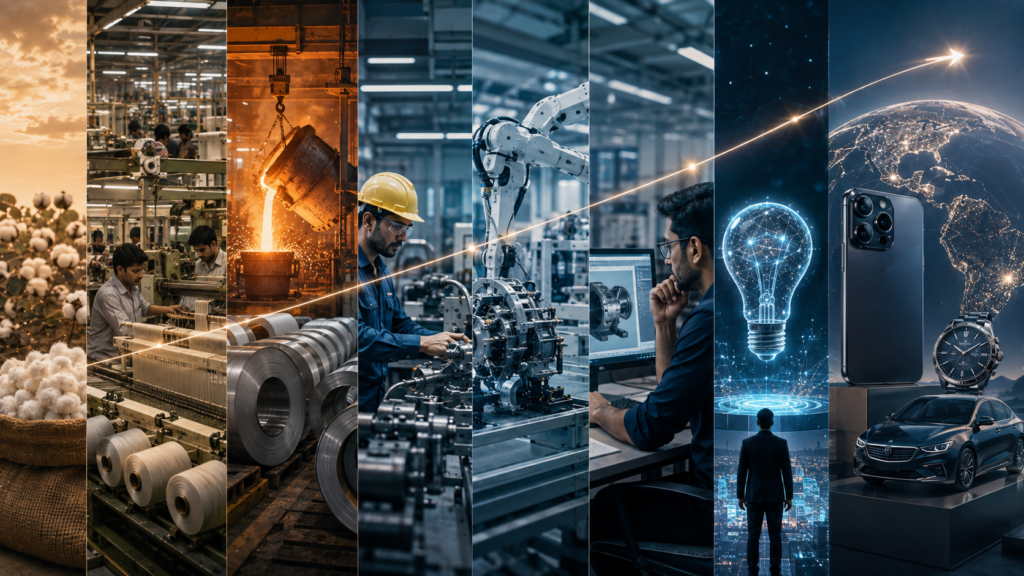
India needs to go further along the path of:
- Higher-value production.
- Intellectual property.
- High-tech engineering.
- Specialist components.
- Branded products.
- Technology exports.
The goal should not be to become the cheapest provider.
This is a strategy with limits.
The true goal is to make yourself indispensable.
That is also where long-term investment priorities become important. Our analysis of where India’s smart money is going in 2026 explores the sectors investors believe could define India’s next phase of growth.
Should Indian Exporters Be Worried?
Yes.
But selectively.
This is no reason to conclude that the story of India’s exports is crumbling. The US and India are still very important economic partners, and both governments have continued to cooperate on a wider trade framework.
But recent tariff measures make it obvious that access to the American market is not to be taken for granted.
Indian exporters must now stress-test their firms.
They have to ask:
- What if tariffs increase in the US?
- Can we pass increasing costs on to our customers?
- Can we withstand a shock with our margins?
- Are there other export markets?
- Are we overly reliant on one American customer?
- Can local value addition be improved?
- Do we have sufficient pricing power?
These are not matters of theory anymore.
Those are strategic questions.

The Bottom Line
Donald Trump’s tariff initiatives remind us that globalisation is evolving.
For decades, businesses assumed that the world was slowly becoming more linked, more integrated and more open.
This assumption is getting hazardous.
The new world of commerce is:
- More politicised.
- More protectionist.
- More fragmented.
- And increasingly unpredictable.
India can still gain a lot from this disruption.
The broader trade environment matters too. India’s changing import and export equation was explored in our analysis of whether India’s rising trade deficit should worry businesses.
Indeed, if global supply chains further move away from dependence on China, the country might be one of the largest beneficiaries.
But India should not mistake opportunity for immunity.
America might need India.
India might need America too.
But in trade relations between countries, national interests are more and more prevailing over goodwill.
The message to Indian exporters is clear.
Don’t wait for Washington to decide your future.
- Diversify your markets.
- Build better products.
- Increase value addition.
- Don’t rely on a single geography.
- And, most crucially, avoid competing on price alone.
Because in Trump’s world, a tariff can change overnight.
But a business that’s difficult to replace has something much more valuable than a trade deal.
It has leverage.