
For decades, India followed a familiar life pattern.
- Study hard
- Maintain high grades
- Obtain a secure job
- Stay with the same company for several years
- Invest in a house
- Build a predictable future
Stability was not merely a financial objective.
It was a cultural aspiration.
- Parents desired it
- Families respected it
- Society rewarded it
Many believed that securing a government job represented the pinnacle of success. A long corporate career symbolized achievement. Risk was approached cautiously, and uncertainty was something to be avoided.
However, a silent shift is taking place across India.
An increasing number of young Indians are beginning to prioritize something very different:
Freedom
- Freedom from rigid structures
- Freedom from conventional definitions of success
- Freedom from predictable paths
This shift is fundamentally changing how India:
- works
- spends
- builds businesses
- chooses careers
- imagines the future
Welcome to one of the most significant behavioral transformations shaping modern India.
The rise of alternative career paths also reflects trends discussed in the emergence of AI-powered one-person companies.

A New Indian Dream Is Emerging
Previous generations often had a very clear understanding of success.
Typically, it included:
- a secure job
- a fixed monthly income
- home ownership
- long-term peace of mind
- a predictable career path
The objective was straightforward:
Eliminate uncertainty.
Today, success for younger Indians increasingly looks different.
It often includes:
- liberty and independence
- meaningful work
- ownership of time
- lifestyle choices
- financial independence
A growing number of people are aiming for:
Greater control over their own lives.
That distinction matters significantly.
The future of work is rapidly evolving due to technology and changing workforce preferences, according to research from the World Economic Forum.
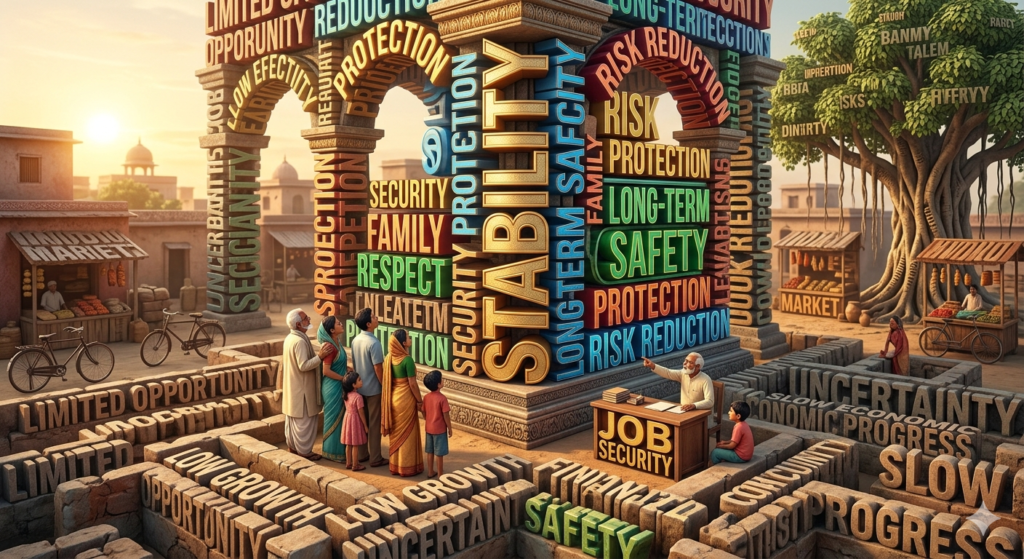
Why Stability Was So Important Earlier
To understand this shift, it is important to understand India’s past.
Economic uncertainty influenced behavior for decades.
Many families experienced:
- limited opportunities
- lower income security
- fewer career choices
- slower economic growth
Under such conditions, stability made sense.
Secure employment represented:
- protection
- financial security
- social respect
- long-term safety
Stability reduced risk.
Why Younger Indians Think Differently
The current generation grew up in a very different India.
They experienced:
- smartphones
- global content
- startup culture
- creator economies
- social media
- digital payment systems
- international exposure
Unlike earlier generations, many did not inherit the same scarcity mindset.
Instead, many grew up seeing abundance and opportunity.
That naturally changes perspectives.
Changing aspirations are becoming increasingly visible across smaller cities, as explored in the rise of Bharat consumers and emerging markets.
Exposure Changed Aspirations
Exposure may be one of the biggest drivers behind this shift.
The internet dramatically expanded visibility.
Young Indians today can see:
- entrepreneurs building businesses
- creators earning online
- professionals working remotely
- freelancers earning globally
- individuals building unconventional careers
Earlier, career opportunities often appeared limited.
Today:
Possibilities appear almost limitless.
Changing workplace expectations and workforce behavior continue to reshape employment trends globally, according to McKinsey research.
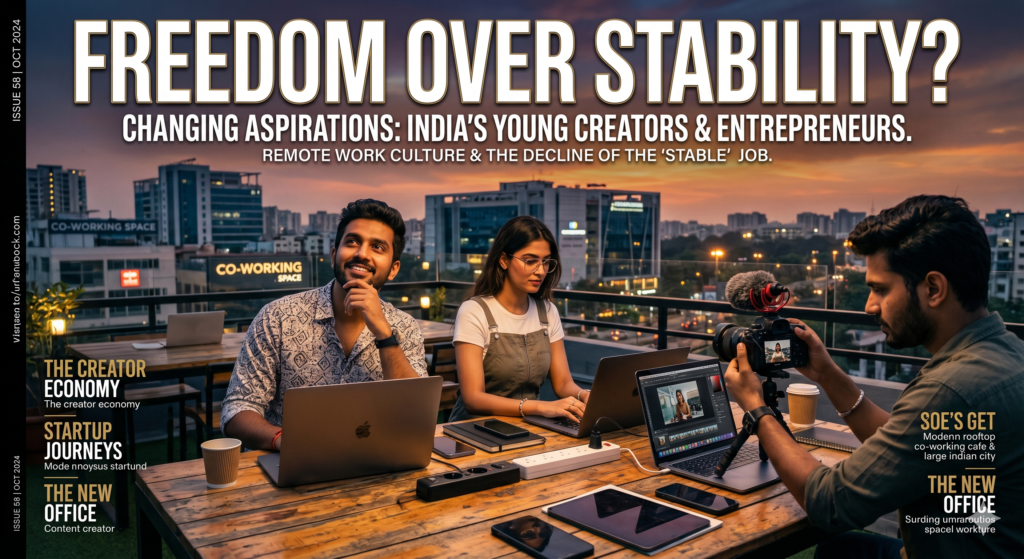
The Internet Changed Success Stories
For many years, career success followed a fairly fixed hierarchy.
Examples included:
- doctor
- engineer
- government officer
- corporate executive
However, digital platforms introduced entirely new opportunities.
Today, people can become:
- creators
- consultants
- startup founders
- freelancers
- online educators
- digital entrepreneurs
Many young Indians increasingly realize:
There are multiple ways to build a successful life.
India’s digital transformation has accelerated through initiatives such as Digital India.
The Rise of Time Wealth
One of the biggest changes is that more young people now value time itself.
Earlier generations optimized for:
👉 Financial stability
Younger generations increasingly optimize for:
👉 Lifestyle flexibility
Questions increasingly include:
- Can I work remotely?
- Can I travel?
- Can I control my schedule?
- Can I reduce long commutes?
- Can I achieve better work-life balance?
The idea of wealth itself is evolving.
Increasingly, people define wealth as:
Having control over time.
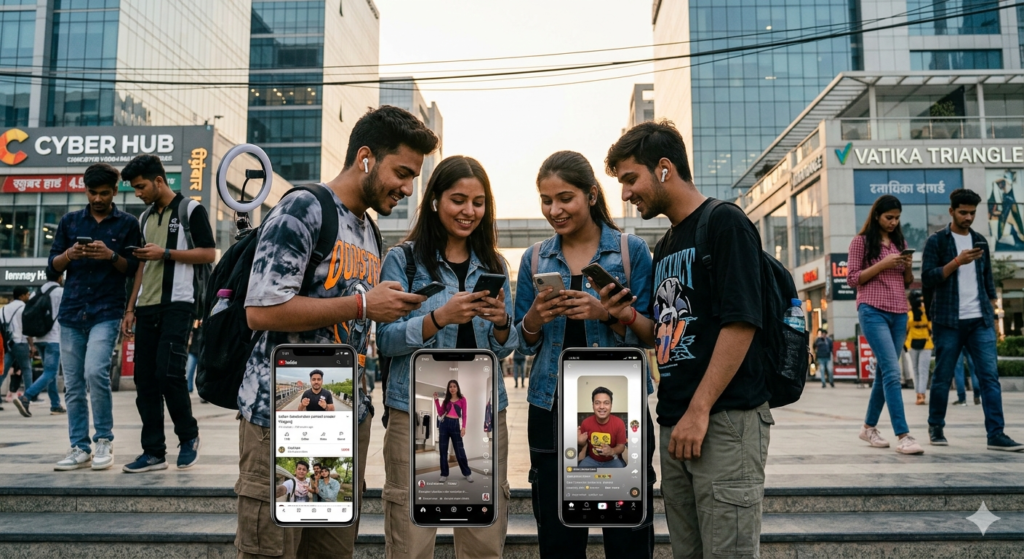
The Pandemic Accelerated Everything
COVID-19 dramatically shifted priorities.
The pandemic forced millions to rethink:
- work culture
- health
- family relationships
- quality of life
Many professionals realized:
- long commutes consumed valuable time
- rigid office systems felt exhausting
- work could happen remotely
- life outside large cities felt different
The pandemic accelerated a question many had already started asking:
Is stability alone enough?
Work Is No Longer Only About Salary
Compensation remains important for younger Indians.
However, work increasingly includes additional factors.
Job decisions are now often influenced by:
- adaptability
- culture
- learning opportunities
- purpose
- autonomy
- growth potential
Earlier:
Salary largely influenced decisions.
Today:
Lifestyle increasingly influences decisions.
Digital-first ambitions are also shaping a new generation of India-first startups and businesses.
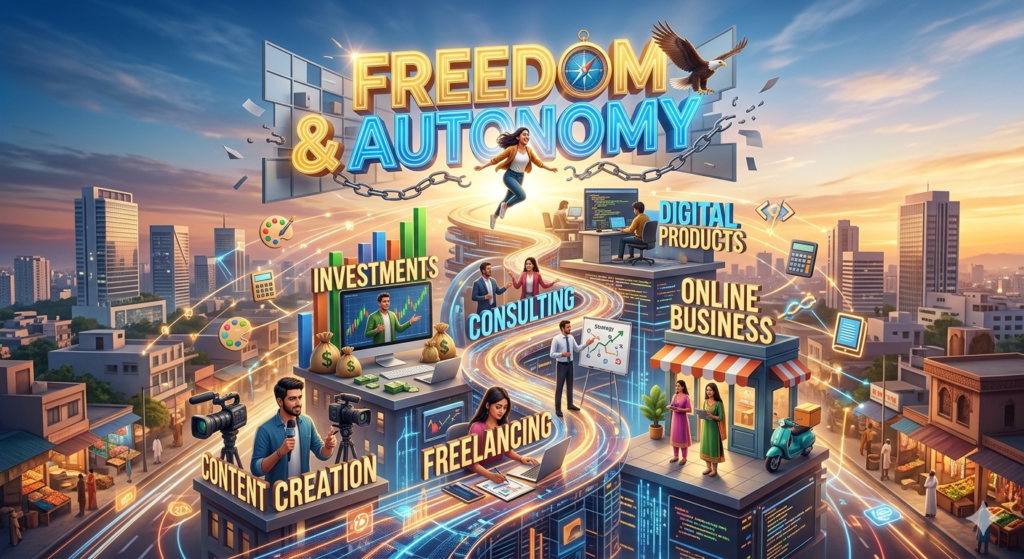
The Rise of Side Hustle India
The rise of side hustles is a significant indicator of this shift.
Young professionals are increasingly participating in:
- content creation
- freelancing
- investments
- consulting
- online businesses
- digital products
Why?
Because side hustles frequently represent more than income.
They often represent:
Freedom and autonomy.
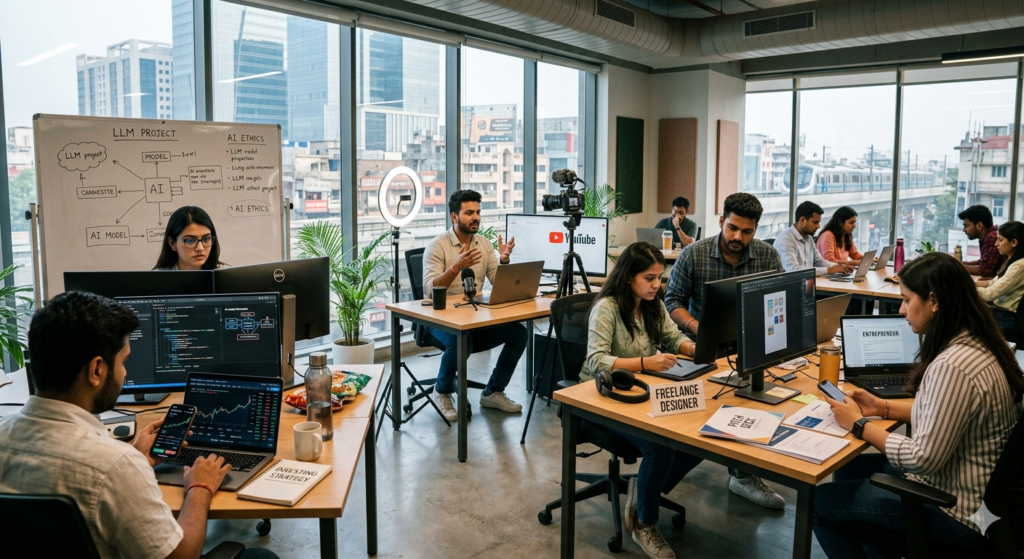
The Creator Economy Changed Ambition
Social media significantly increased the visibility of alternative careers.
Young Indians increasingly follow:
- creators
- founders
- educators
- investors
- entrepreneurs
People are generating income through:
- content
- communities
- subscriptions
- digital products
- brand collaborations
This creates a major shift in aspiration.
Success no longer appears tied exclusively to traditional careers.
Creator-led careers have expanded significantly through platforms like YouTube and Instagram.
The rapid rise of creator-led careers aligns closely with broader shifts explored in the evolution of AI, creators, and searchless internet behavior.
Financial Freedom Replaced Traditional Security
A major psychological shift is taking place.
Earlier:
People wanted secure jobs.
Today:
Many increasingly seek financial freedom.
The two are not always identical.
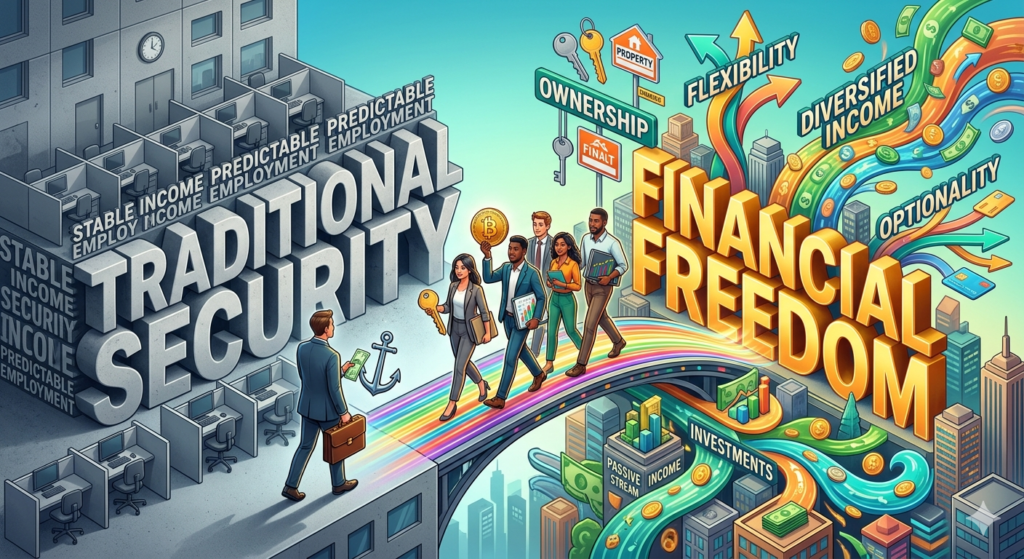
Job security often means:
- stable income
- predictable employment
Financial freedom increasingly means:
- ownership
- flexibility
- diversified income streams
- optionality
Young consumers increasingly focus on building:
- investments
- passive income
- digital assets
- side businesses
Freedom Also Comes With Risks
While this transition is exciting, it also brings challenges.
The pursuit of freedom can sometimes create:
- uncertainty
- instability
- burnout
- comparison pressure
- inconsistent income
Social media often creates highly curated images of success.
People may underestimate:
- financial risks
- emotional stress
- long-term planning requirements
Freedom without structure can sometimes become overwhelming.
India’s startup ecosystem continues to evolve rapidly with support from initiatives like Startup India.
Freedom vs Stability May Be the Wrong Debate
The conversation is often framed incorrectly.
It is not always:
Freedom versus stability.
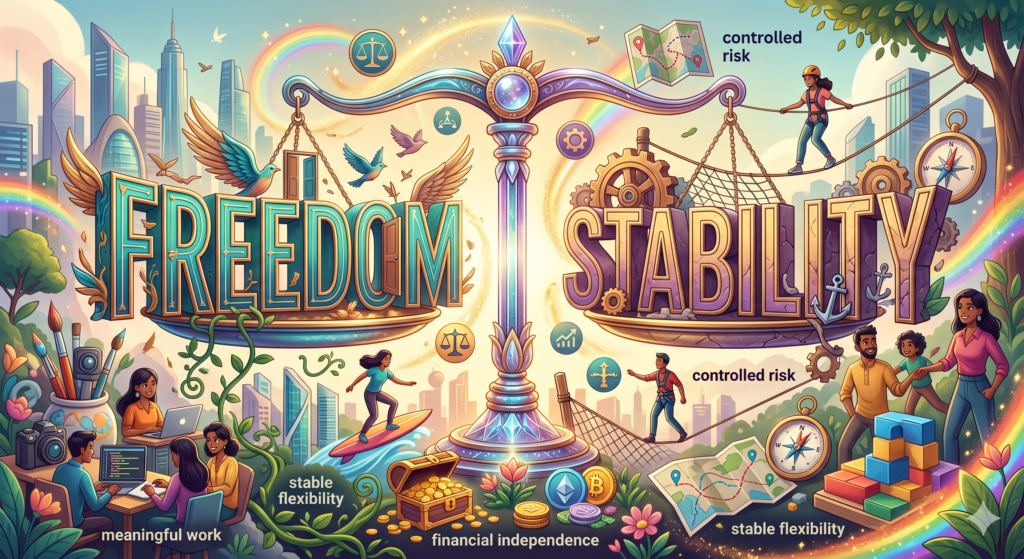
Increasingly, people want:
Both.
Young Indians are not necessarily rejecting security.
Instead, they increasingly seek:
- meaningful work
- controlled risk
- stable flexibility
- financial independence
The goal is balance.
Why Businesses Should Pay Attention
This shift could significantly impact companies.
Organizations increasingly need to rethink:
- hiring strategies
- retention models
- work culture
- employee expectations
Younger talent increasingly values:
- flexibility
- purpose
- learning
- growth opportunities
Companies built on older assumptions may struggle.
What This Means for India
This transformation could reshape:
- careers
- entrepreneurship
- housing trends
- consumption patterns
- workplace culture
Future generations may build their lives differently.
They may:
- work from multiple locations
- pursue multiple income streams
- change careers more frequently
- prioritize experiences over ownership
The Bigger Shift: India Is Redefining Success
Perhaps the biggest shift is philosophical.
For decades:
Success meant predictability.
Today:
Success increasingly means choice.
The ability to choose:
- where to live
- how to work
- what to build
- how to spend time
may become one of the most valuable forms of wealth.
Conclusion
India is quietly experiencing a generational mindset shift.
Young Indians are not simply rejecting stability.
They are redefining it.
Because for many people today, success is no longer defined solely by income.
It is increasingly about:
- making choices
- controlling time
- creating flexibility
- designing life intentionally
The new Indian dream may no longer be:
“Find the safest path.”
Increasingly, it may become:
“Build the freedom to choose your own path.”
The future of success may increasingly depend on balancing freedom, stability, and long-term financial independence.
