
India likes talking about startups.
Every few weeks, there is another fundraising announcement, another founder on a magazine cover, another billion-dollar valuation, and another debate about whether India can generate the next global technology behemoth.
India has proven that it can develop startups.
The country has founders. It has engineers. Its digital audience is enormous. It has strong technology talent, digital public infrastructure, and a startup ecosystem that has grown substantially over the past decade.
India’s startup ecosystem has expanded dramatically over the past decade, supported by government initiatives such as Startup India, which has helped build a broader ecosystem for entrepreneurship, investment and innovation.
India generates ideas. It produces entrepreneurs. It even produces unicorns.
But a far more difficult question is often ignored:
Can India fund its companies long enough for them to become truly global businesses?
Because establishing a company and scaling one are two very different challenges.
India may have solved its startup problem, but it still has a significant scale-up capital problem.
The next decade may not be about how many startups India creates. It may be about whether India has enough patient, long-term capital to help its best companies become the next Reliance Industries, Infosys, Tata Consultancy Services, or global technology giants.

India Has Many Startups. It Needs Bigger Companies.
India’s startup ecosystem has changed dramatically from the days when entrepreneurship was considered an unusual career choice.
Today, founders are building businesses across practically every industry, including:
- Artificial Intelligence
- FinTech
- SaaS
- DeepTech
- E-commerce
- Healthcare
- Defence technology
- Manufacturing
- Robotics
- Climate technology
Early-stage finance is also more accessible than it was a decade ago.
Angel investors, accelerators, incubators, seed funds, venture capital firms, and startup-focused investment platforms are increasingly supporting talented founders.
The problem is what happens next.
Raising the first few crores is difficult, but increasingly feasible. Raising enough capital to grow a ₹50 crore business into a ₹5,000 crore or ₹50,000 crore enterprise is an entirely different challenge.
At that stage, India needs more of one thing:
Patient growth capital in abundance.
India’s startup ecosystem has also continued to evolve through the government’s DPIIT Startup Recognition framework, which provides recognised startups access to a range of ecosystem and policy benefits.
India’s future business success may also come from companies operating far away from the startup spotlight, including businesses you’ve probably never heard of that quietly generate hundreds of crores in revenue.
“India’s next challenge is no longer proving that it can create startups. It is building the financial depth required to help its most successful companies become globally significant enterprises.”— Bharat Samachar Editorial

India Funds Ideas Well. Scaling Them Is More Difficult.
A startup can survive on relatively limited funding during its early years.
A few angel investors can fund an initial business. A seed fund can help build the team. Series A investors can finance early growth.
However, successful companies eventually face much larger challenges.
They may need to:
- Build large factories.
- Expand internationally.
- Prioritise research and development.
- Recruit senior leadership.
- Acquire competitors.
- Build worldwide distribution networks.
- Strengthen supply chains.
- Survive economic downturns.
- Continue investing before significant profits arrive.
This is where financial requirements shift dramatically.
Startups no longer need money simply to prove that an idea works. They need capital to capture and dominate a market.
And dominance costs money.
Sometimes, an extraordinary amount of it.
India has become better at producing startups, but it still lacks enough of the financial infrastructure required to consistently scale companies into global enterprises.

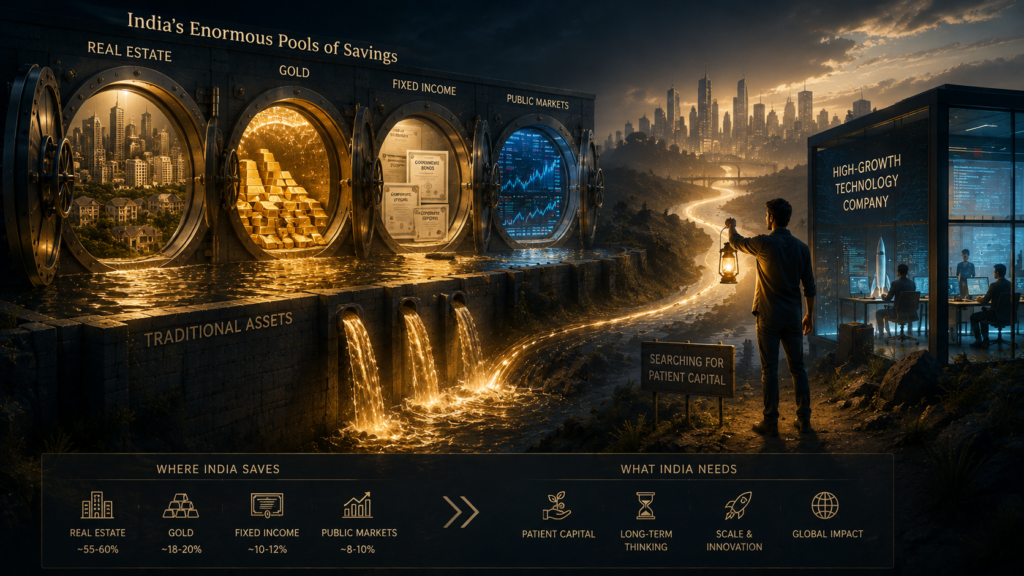
The Problem Isn’t Capital. It’s the Type of Capital.
India is not impoverished when it comes to savings.
Indian households save. Indian companies have substantial balance sheets. Insurance companies operate massive pools of capital. Pension and retirement funds hold significant long-term assets, while family offices are becoming increasingly influential.
The issue is that capital and risk capital are not the same thing.
Much of India’s domestic capital remains invested in familiar asset classes such as:
- Public equities
- Fixed-income securities
- Real estate
- Gold
- Established companies
- Government-backed securities
Scaling a technology or DeepTech company, however, requires a different appetite for risk.
The investment may remain illiquid for years. The company may need multiple funding rounds, and its valuation may fall before rising again. Business models may mature later than expected.
Sometimes, investments simply fail.
That makes scale-up investing uncomfortable.
However, some of the greatest long-term returns are created precisely because investors are willing to accept that discomfort.
India already has a growing alternative investment ecosystem, regulated through the SEBI Alternative Investment Fund framework, but the larger challenge is building deeper pools of long-duration capital willing to support companies through their scale-up journey.
India’s Growth Still Relies on Foreign Investors
This is where the discussion becomes more contentious.
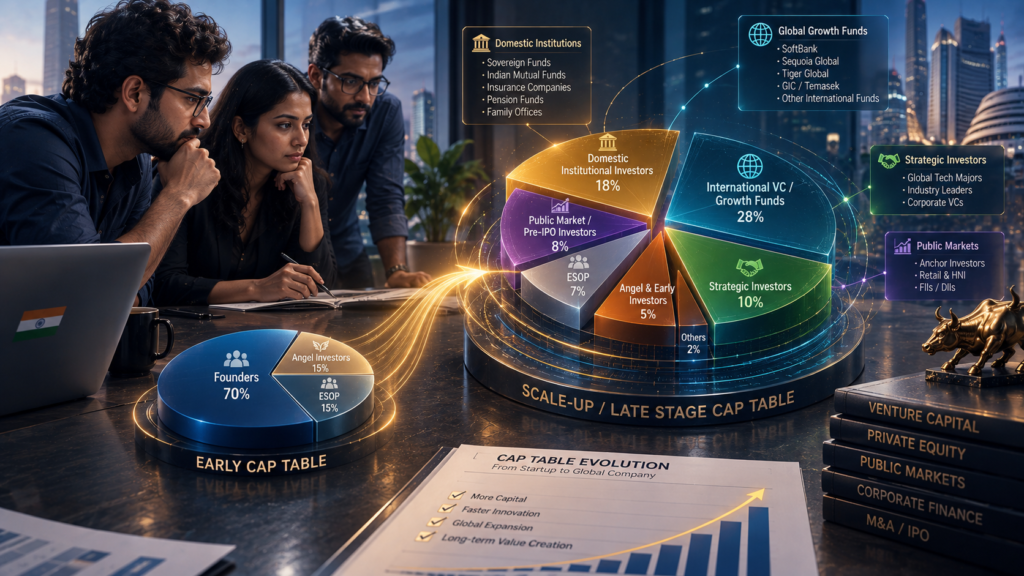
Many of India’s most ambitious companies have relied heavily on international investors during critical stages of their growth.
Global venture capital firms, private equity funds, sovereign wealth funds, and international institutions have helped finance the rapid expansion of Indian businesses.
That is not necessarily a bad thing.
Foreign capital played a crucial role in establishing India’s startup ecosystem, and many companies would probably have grown far more slowly without it.
Foreign investors have also brought:
- Global networks
- Governance expertise
- Access to international markets
- Experience in scaling companies
- Follow-on capital
- Strategic relationships
Again, this is not an argument against foreign investment. In fact, the question of whether India builds startups while foreign investors own a significant part of the upside is becoming an increasingly important conversation for India’s innovation economy.
The bigger question is:
As Indian companies grow, why isn’t more Indian capital sitting alongside foreign investors?
Because when companies generate significant wealth through public listings, acquisitions, or global expansion, the financial upside ultimately goes to those who own the equity.
And ownership matters.
A lot.
India Cannot Become a Startup Factory for Global Investors
This is where the argument becomes controversial.
India risks becoming exceptionally good at creating the ingredients required to build valuable companies while allowing a disproportionate share of their long-term financial rewards to flow elsewhere.
Indian entrepreneurs build companies, while engineers create the technology that powers them. Employees then scale operations, consumers create the market, and infrastructure provides the foundation for growth.
As India’s startup ecosystem matures, platforms such as Startup India are also increasingly focused on strengthening connections between entrepreneurs, investors and the broader innovation ecosystem.
However, when companies require significant amounts of growth capital, international investors often remain among the most important sources of funding.
Again, this is not an argument against foreign investment.
India should want global investors competing to invest in its best companies.
The problem is dependency.
When a promising company enters its next major stage of growth, a mature startup ecosystem should not have to rely disproportionately on external capital.
India needs more domestic institutions capable of writing substantial cheques and waiting patiently for the outcome.
“The real question is not whether India should welcome foreign capital. It should. The question is whether Indian capital is participating enough in the upside created by India’s own innovation economy.”— Bharat Samachar Editorial

Patient Capital Is Still Missing
India’s next startup revolution may depend less on creating more founders and more on creating more long-term investors.
The country needs a deeper ecosystem of:
- Domestic growth equity funds
- Venture capital firms with larger pools of capital
- Family offices willing to take concentrated risks
- Corporate venture funds
- Institutional investors, where regulations permit
- DeepTech-focused capital
- Long-duration investment vehicles

India also needs successful entrepreneurs to reinvest in the next generation of businesses.
This is already beginning to happen.
Successful entrepreneurs are becoming angel investors and venture capitalists. Business families are developing dedicated investment platforms, while large companies are increasingly considering strategic investments.
However, the ecosystem still needs far greater depth.
A country of India’s economic size should produce more than founders capable of building billion-dollar companies.
It should also produce investors capable of funding their difficult journey.
Creating deeper pools of domestic growth capital will also depend on the continued evolution of India’s alternative investment ecosystem, which is governed by SEBI’s Alternative Investment Fund regulations and related framework.
India’s Next Startup Debate
Are Indian startups facing a funding problem—or is the real challenge the lack of patient capital required to build global companies?
The next decade may determine who owns India’s innovation economy.

The Scale-Up Gap Threatens DeepTech Even More
The problem becomes particularly significant in sectors such as:
- Semiconductors
- Aerospace
- Defence
- Advanced manufacturing
- Robotics
- Biotechnology
- Quantum computing
- Energy technology
These businesses cannot always follow the traditional startup playbook.
A tiny team, a laptop, and a few million dollars in venture funding cannot develop a semiconductor company. Without infrastructure, advanced manufacturing is impossible.
And if investors expect returns within two or three years, building breakthrough technologies becomes extremely difficult.
DeepTech takes time.
Patience, therefore, requires capital that understands long development cycles.
India wants to become a global technology and manufacturing power. That ambition is achievable.
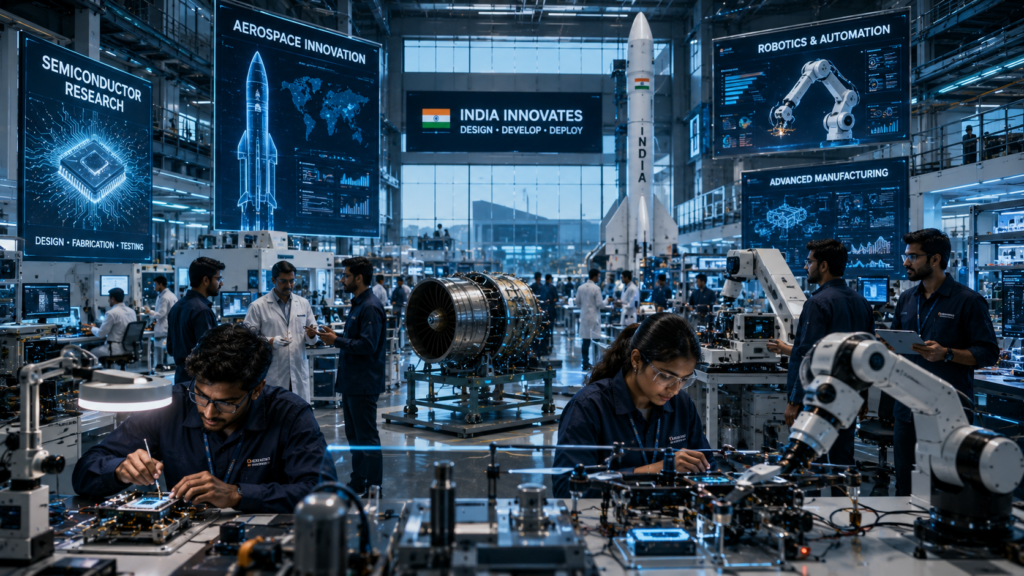
However, ambition without capital can eventually become nothing more than a PowerPoint presentation.
The next generation of Indian industrial companies will need investors willing to wait through years of experimentation, failure, research and infrastructure development.
The same challenge becomes even more important as India begins building companies around Artificial Intelligence, an opportunity that could transform not just startups but millions of traditional businesses, as explored in The ₹490 Billion AI Opportunity Hidden Inside India’s MSMEs.

Scale and Valuation Are Different Things
India’s startup ecosystem also needs to stop focusing obsessively on one number:
Valuation.
Becoming a unicorn does not automatically mean a company is great.
As Bharat Samachar has explored before, cash flow is often far more important than headline revenue when it comes to building a sustainable business.
Billion-dollar valuations can disappear surprisingly quickly.
Real scale looks different.
It means:
- Sustainable revenue
- Strong cash flow
- Global customers
- Defensible technology
- Efficient operations
- Long-term ownership
- The ability to survive without continuously raising capital
India should continue to celebrate fundraising achievements.
However, perhaps it should celebrate companies generating ₹10,000 crore in sustainable revenue even more.
Because companies become institutions when they stop being exciting experiments and begin building enduring businesses.

India Needs to Think Beyond the Next Funding Round
For too long, startup success has been measured by how quickly a company raises its next round.
The journey typically begins with seed funding, followed by Series A, Series B and Series C rounds.
Unicorn status.
IPO.
Somewhere along the way, fundraising itself began to look like the objective.
The real challenge for founders is not simply raising the next round, but building businesses with the discipline, resilience and long-term thinking required for sustainable growth—a theme also explored in The New Playbook for Indian CEOs.
The next phase of India’s startup ecosystem needs to be more ambitious.
It should focus on creating companies capable of surviving, scaling and dominating without permanently depending on external funding.
That requires founders to think differently.
It also requires investors, governments and institutions to think differently.
India may not necessarily need another 100,000 startups.
What it needs is more genuinely large-scale companies.
India’s corporate history shows what patient capital, long-term ambition and relentless execution can eventually create, as demonstrated by The Reliance Story.
“A country that wants to build the next generation of global companies cannot only produce entrepreneurs. It must also produce the capital willing to stay with them for the entire journey.”— Bharat Samachar Editorial

Conclusion: India Must Fund Its Future
India has already shown that it can produce world-class entrepreneurs.
The talent exists. The markets exist. The technology exists.
And the ambition certainly exists.
What India now needs is a stronger domestic financing ecosystem capable of supporting companies after their initial startup stage.
The next Reliance may not begin as a petrochemical company.
It could be:
- An AI infrastructure company
- A semiconductor manufacturer
- A defence technology business
- A robotics platform
- A global SaaS company
- Or a company operating in an industry that barely exists today
If India wants to own a larger share of that future, it must go beyond simply celebrating founders.
It must also fund their growth.

Foreign investors should continue to remain important. India needs global investment, international relationships and global expertise.
But India should also cultivate patient domestic capital capable of standing alongside them.
Because starting a business is only the beginning.
Building a company capable of changing an industry can take decades.
Unless India develops the ability to finance that journey, it may continue producing world-class companies while allowing a significant portion of their long-term upside to be owned elsewhere.
India’s startup problem may be over.
Its bigger challenge is finding enough capital to scale—and own—the future it is busy creating.
