
Introduction: Why Interest Rates Matter More Than Ever
The interest rate impact on Indian startups has become one of the most defining forces shaping the ecosystem today. Over the past few years, global interest rate movements have directly influenced funding, valuations, and growth strategies across India’s startup landscape.
Decisions made by central banks like the US Federal Reserve have rippled across global markets, impacting how capital flows into emerging economies like India. For Indian startups—especially those reliant on venture capital—these shifts have fundamentally changed how businesses are built, funded, and scaled.
This macro shift is closely tied to trends in the global startup ecosystem.
As a result, Indian startups have had to rethink how they build, fund, and scale businesses.
“Tighter monetary policy reduces liquidity and risk appetite across global markets.” — International Monetary Fund
As the world now stands at a potential turning point in the interest rate cycle, the big question is:
What does this mean for India’s startup ecosystem?
The Global Context: From Easy Money to Tight Liquidity
Between 2020 and 2021, global markets experienced an era of ultra-low interest rates. Capital was abundant, borrowing was cheap, and investors were aggressively deploying funds into startups worldwide.
This led to:
- Record-breaking funding rounds
- Sky-high startup valuations
- Rapid expansion across markets
However, rising inflation forced central banks to reverse course. The Federal Reserve began aggressively increasing interest rates, triggering a global liquidity squeeze.
As a result, global liquidity shrank significantly.
This shift also aligns with broader macro trends discussed in the future of work and economy.

The consequences were immediate:
- Venture capital funding slowed down
- Risk appetite declined
- Investors shifted toward safer assets
For emerging markets like India, this translated into reduced foreign capital inflows and tighter funding conditions.
Impact on Indian Startups: A Reality Check
India’s startup ecosystem—once riding a wave of abundant capital—suddenly faced a new reality.
1. Funding Winter
The most visible impact was the onset of a “funding winter.”
- Venture capital investments declined significantly
- Late-stage funding rounds became rare
- Startups struggled to raise follow-on capital
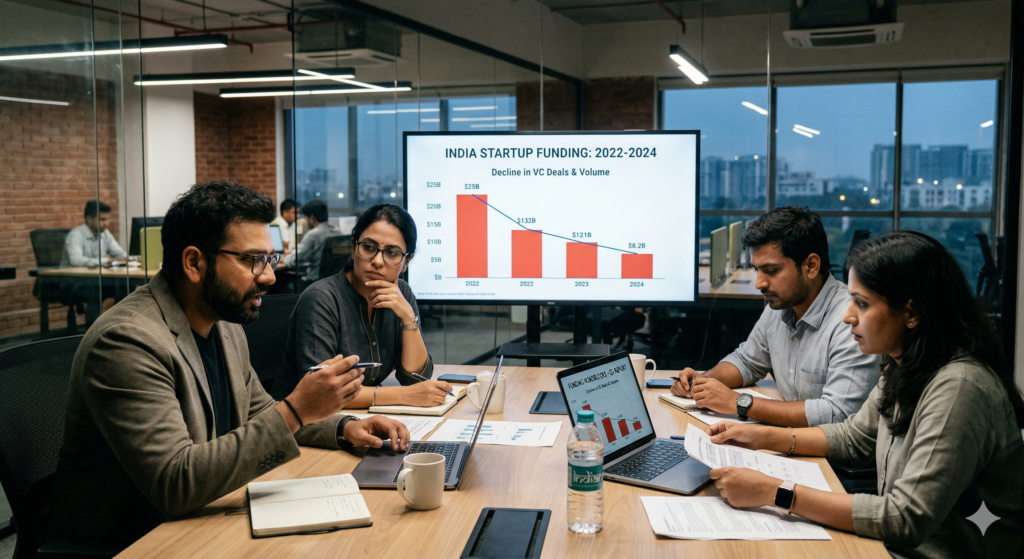
Investors became more cautious, prioritizing capital efficiency over aggressive expansion.
2. Valuation Reset
The era of inflated valuations gave way to a much-needed correction.
- Down rounds became more common
- Unicorn creation slowed dramatically
- Public market listings faced pressure
This reset, while painful, has brought more realism into startup pricing.
This aligns with shifts explained in venture capital dynamics.

3. Shift in Founder Mindset
Perhaps the most important change has been psychological.
Startups that once focused on:
- Rapid user acquisition
- Market share dominance
- Burn-driven growth
Are now prioritizing:
- Profitability
- Sustainable growth
- Strong unit economics
This marks a maturation of India’s startup ecosystem.
“In a constrained capital environment, efficiency becomes the new growth.” — Sequoia Capital
Strategic Shifts Across the Ecosystem
The interest rate cycle hasn’t just changed funding—it has reshaped strategy across stakeholders.
For Startups
- Reduced burn rates and optimized operations
- Focus on core markets instead of aggressive global expansion
- Increased emphasis on monetization models
Many startups are now building resilient businesses rather than just scalable ones.

For Investors
- Preference for early-stage deals with long-term upside
- Greater scrutiny on business fundamentals
- Shift toward sectors with clear revenue visibility
Global firms like Sequoia Capital and SoftBank have recalibrated their investment strategies, impacting Indian startups directly.
For Talent
- Hiring slowdowns across startups
- Increased focus on productivity over expansion
- Rise of contract and gig-based roles
The talent market has become more balanced after years of hyper-competition.
Hiring has slowed while productivity expectations have increased.
The Flip Side: Challenges for India
While the correction has brought discipline, it has also created challenges:
1. Slower Innovation Cycles
With funding harder to access, risk-taking has reduced—especially for deep-tech and experimental ideas.
2. Startup Mortality
Startups dependent on continuous funding rounds are struggling to survive.
3. Reduced Global Capital Flows
As global investors seek safer returns in developed markets, emerging economies like India face capital constraints.

The Silver Lining: Why This Is Good for India (Long Term)
Despite short-term pain, this phase could be one of the healthiest resets for India’s startup ecosystem.
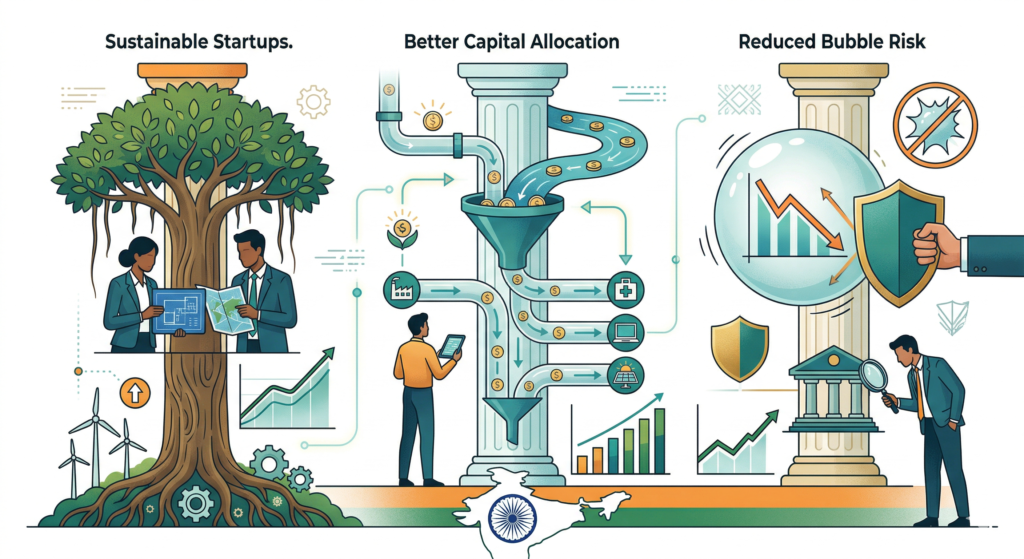
1. Stronger, More Sustainable Startups
Companies built in tough environments tend to:
- Be more disciplined
- Have stronger fundamentals
- Achieve long-term success
2. Better Capital Allocation
Capital is now flowing to:
- Businesses with clear revenue models
- Founders with execution capability
- Sectors with real demand
This improves overall ecosystem quality.
3. Reduced “Bubble Risk”
The correction reduces the risk of:
- Overvaluation crashes
- Unsustainable business models
- Investor-driven hype cycles
This reset is creating stronger startups and better capital allocation. It also aligns with India’s ambition to become a global innovation hub.

What Happens Next: The Turning Point
The global market is now closely watching signals of interest rate cuts.
If central banks—including the Federal Reserve—begin easing rates, several shifts could follow:
1. Return of Liquidity
Lower interest rates mean:
- Cheaper capital
- Increased VC funding
- Renewed investor confidence
India could once again attract significant global capital.

2. Startup Funding Revival
- Late-stage funding rounds may pick up
- Growth-stage startups could see renewed interest
- Mega funding rounds may return
3. IPO Boom Possibility
A favorable interest rate environment could revive:
- Public market listings
- Investor appetite for tech stocks
- Exit opportunities for investors
4. Consolidation & M&A Activity
Stronger startups may acquire weaker players, leading to:
- Industry consolidation
- Stronger market leaders
- Increased efficiency
India’s Strategic Advantage in This Cycle
India is uniquely positioned to benefit from the next phase.
1. Large Domestic Market
Unlike many global startups, Indian companies have:
- A massive and growing consumer base
- Strong demand fundamentals
2. Cost Efficiency
Indian startups operate at:
- Lower costs compared to global peers
- Higher efficiency in capital usage
3. Talent Advantage
India continues to be a global hub for:
- Engineering talent
- Product development
- Digital innovation
4. Global Investor Confidence
Despite short-term slowdowns, India remains a top destination for global capital due to:
- Economic growth prospects
- Digital adoption
- Policy support
What Founders & Leaders Should Do Now
In this evolving environment, Indian startup leaders need to adapt strategically.
Focus on Fundamentals
- Build strong revenue streams
- Prioritize profitability over vanity metrics
Extend Runway
- Optimize costs
- Delay non-essential expansions
Diversify Funding Sources
- Explore debt, strategic investors, and domestic capital
Prepare for the Next Cycle
- Strengthen business models
- Position for rapid scaling when liquidity returns
Conclusion: A Defining Moment for Indian Startups
The global interest rate cycle is more than just a macroeconomic trend—it is a defining force shaping the future of India’s startup ecosystem.
While the era of easy money may be over (for now), what is emerging is a stronger, more resilient, and more mature startup landscape.
As the world inches toward the next phase of the cycle, India stands at a critical juncture.
Those who adapt today will not just survive—but lead the next wave of innovation.