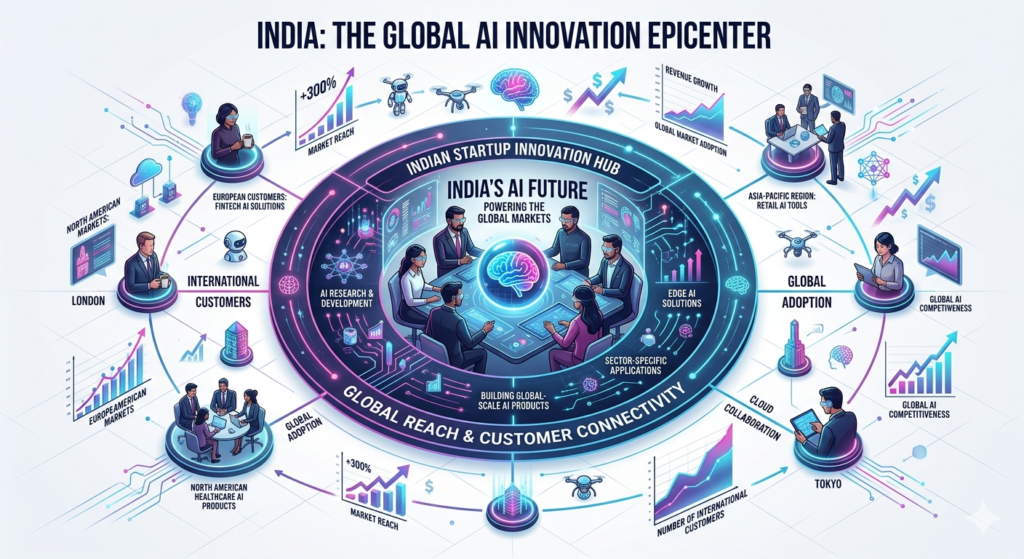
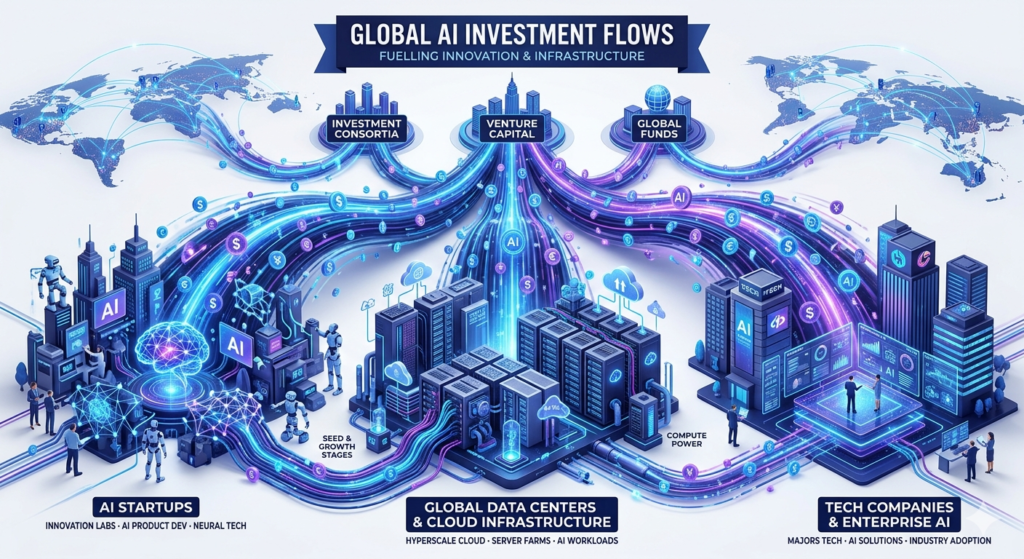
Artificial intelligence has rapidly become the center of gravity for global technology investment. Over the past two years, venture capital firms, technology giants, and institutional investors have poured billions of dollars into AI startups, infrastructure providers, and generative AI platforms.
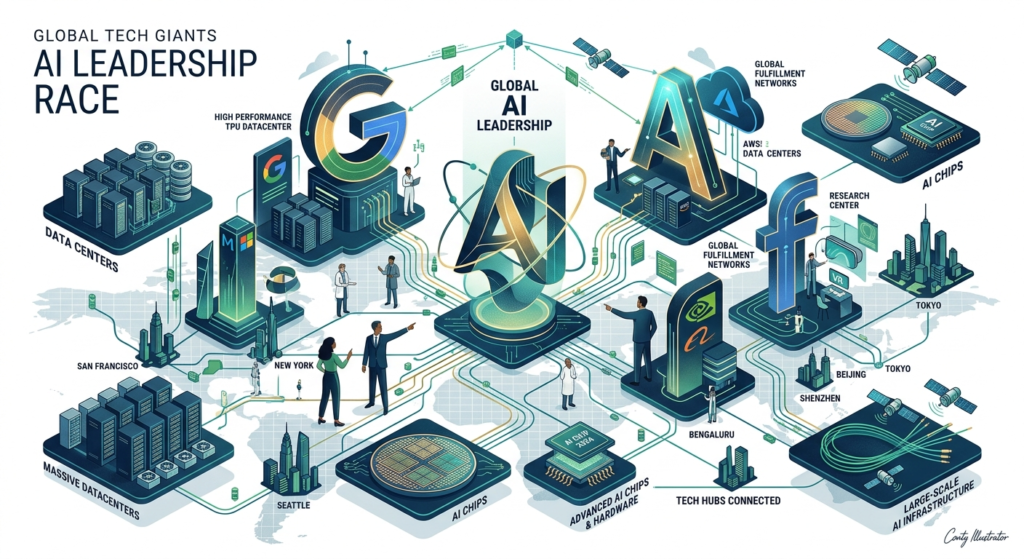
The scale of investment is unprecedented. Global technology companies such as Microsoft, Google, Amazon, and Meta are committing tens of billions of dollars toward building AI models, data centers, and developer ecosystems.
At the same time, venture capital firms have made AI the dominant investment theme across global startup markets, with early-stage funding rounds increasingly concentrated in AI-driven companies.
This surge has inevitably raised a question that investors and entrepreneurs are beginning to debate more openly:
Are we witnessing the early stages of a transformational technology revolution—or the formation of another technology bubble?
The Scale of the AI Investment Wave
The current investment cycle in AI is being driven by two parallel forces.
First, large technology companies are racing to build foundational AI platforms that could define the next generation of computing. Second, venture capital firms are aggressively backing startups building applications on top of these emerging AI capabilities.
Executives at major technology companies believe AI represents a platform shift comparable to the rise of the internet or the smartphone.
Satya Nadella, CEO of Microsoft, has described artificial intelligence as “the defining technology of our time.” Under his leadership, Microsoft has invested heavily in AI infrastructure and partnerships, including its multibillion-dollar collaboration with AI research companies.
Similarly, Sundar Pichai has emphasized that AI will reshape nearly every digital product category. Google has been rapidly integrating AI capabilities across its services—from search and cloud computing to productivity software.
Meanwhile, semiconductor companies are also experiencing unprecedented demand driven by AI infrastructure. Jensen Huang has repeatedly noted that AI computing demand is accelerating faster than many previous technology cycles.
“We are at the beginning of a new computing era driven by artificial intelligence,” Huang said in recent industry discussions.
This massive infrastructure buildout is one reason why AI investment volumes have surged so quickly.
Echoes of Past Technology Booms
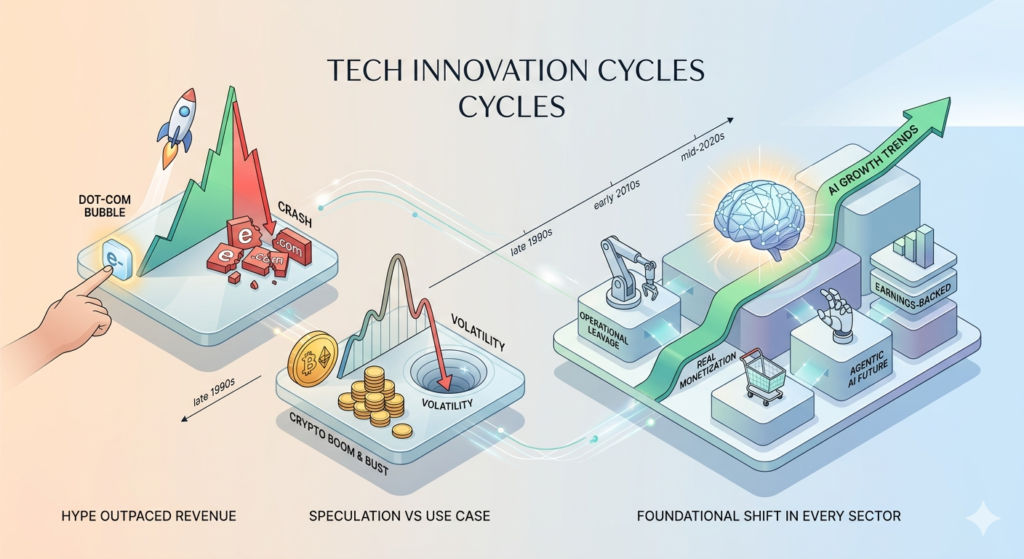
Despite the excitement, the AI investment surge inevitably invites comparisons with earlier technology bubbles.
The dot-com boom of the late 1990s, the cryptocurrency startup wave, and even the SaaS funding explosion of the past decade all experienced similar cycles of enthusiasm, overinvestment, and eventual market corrections.
In each case, capital flowed rapidly into emerging technology companies as investors attempted to capture early leadership positions.
Some industry observers believe the current AI boom could follow a similar pattern.
The rapid proliferation of AI startups—many of which are building similar products or relying on the same underlying models—has raised concerns about whether the market may become saturated.
However, there are important differences between the current AI wave and earlier speculative cycles.
As Uday Kotak has cautioned, “Markets can sometimes run ahead of fundamentals,” a reminder that periods of rapid investment can also carry risks of overvaluation.
Why This AI Wave May Be Different
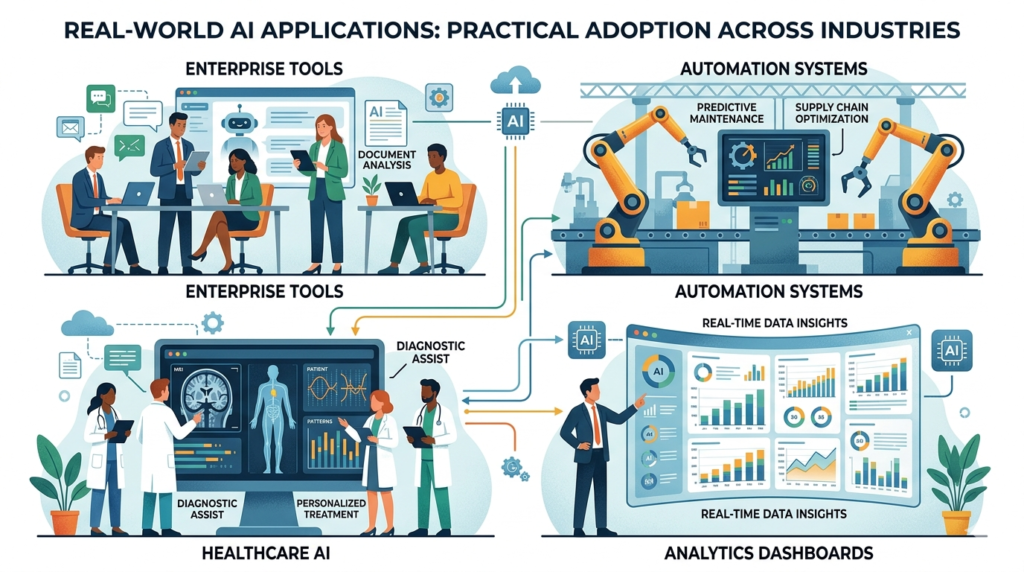
Unlike some previous technology hype cycles, artificial intelligence is already demonstrating clear real-world adoption across industries.
Companies in sectors such as finance, healthcare, logistics, software development, and marketing are actively integrating AI tools into their operations.
Developer platforms, enterprise software systems, and customer service tools are increasingly incorporating AI capabilities to automate tasks, analyze data, and improve productivity.
Sam Altman has argued that AI is likely to become a foundational technology layer across most digital services.
“AI will eventually touch nearly every aspect of the economy,” Altman has suggested in various industry conversations.
If that prediction proves accurate, the long-term impact of artificial intelligence could justify the current level of investment.
In other words, even if the AI market eventually experiences consolidation, the underlying technology is likely to remain transformative.
The Venture Capital Perspective
For venture capital firms, AI presents both enormous opportunity and significant risk.
On one hand, AI startups have the potential to scale quickly if their products successfully integrate into enterprise workflows.
On the other hand, the cost of building foundational AI models can be extremely high, often requiring massive computing resources and infrastructure.
As a result, many investors are beginning to focus on application-layer AI companies rather than startups attempting to compete directly in the development of large-scale foundational models.
This shift in investment strategy mirrors the evolution of earlier technology ecosystems.
During the early days of cloud computing, the most successful startups were often those building software applications on top of cloud infrastructure rather than competing with the cloud providers themselves.
A similar pattern may emerge in the AI ecosystem.
What This Means for India’s AI Ecosystem
For India’s startup ecosystem, the AI investment boom presents a particularly interesting opportunity.
India has several structural advantages in the global AI landscape:
- one of the world’s largest developer communities
- a deep pool of engineering talent
- strong expertise in software development and enterprise platforms
However, building large foundational AI models often requires billions of dollars in computing infrastructure—something that may be more difficult for startups outside major global technology hubs.
Instead, many Indian startups are focusing on AI-powered applications, such as:
- enterprise automation platforms
- developer productivity tools
- fintech analytics solutions
- healthcare AI platforms
This strategy allows companies to leverage global AI infrastructure while focusing on solving specific business problems.
In many ways, this approach mirrors the earlier playbook followed by India’s successful SaaS companies.
Debjani Ghosh has noted that “India is uniquely positioned to become a global hub for AI innovation,” reinforcing the country’s growing role in the global AI landscape.
A Bubble—or the Beginning of a New Technology Era?
The AI investment surge may eventually experience the same market corrections that have shaped previous technology cycles.
Some startups will fail. Others will consolidate. Funding enthusiasm may fluctuate as the market matures.
But the broader impact of artificial intelligence is unlikely to disappear.
The real question facing investors today is not whether AI will reshape the technology landscape—but which companies will ultimately emerge as the leaders of this new era.
And for founders, the lesson may be clear:
The most valuable AI startups will not necessarily be the ones raising the most capital—but those building products that deliver real value in the real economy.