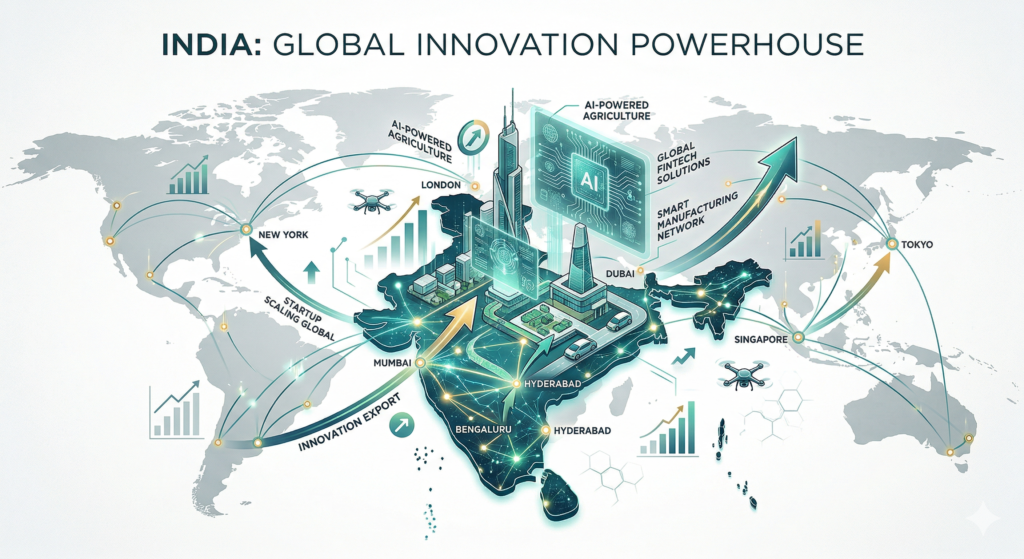
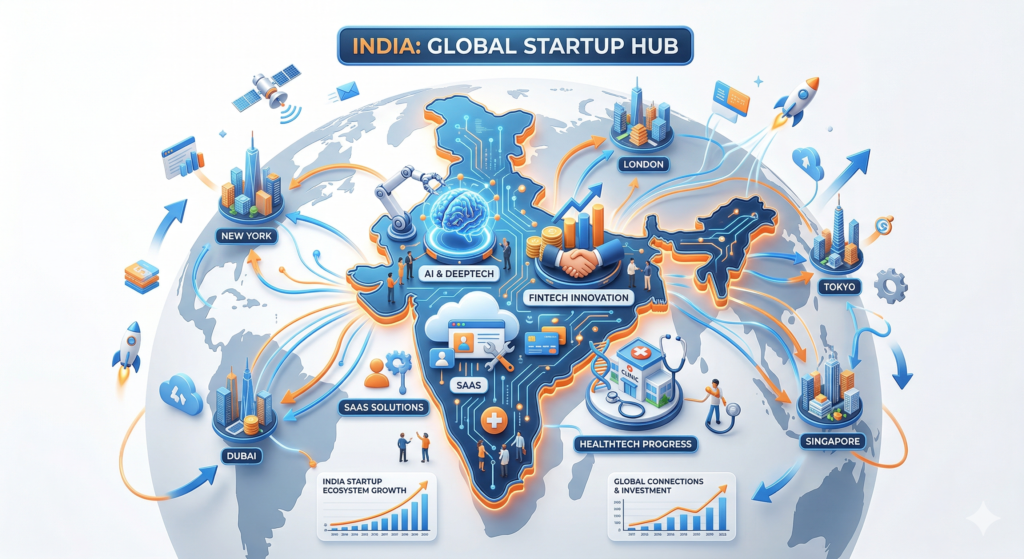
The India startup ecosystem is rapidly evolving into a global hub, driven by innovation, capital, and a new generation of founders building for global markets.
This momentum reflects broader trends in the digital economy of India, where startups are driving innovation at scale.
From fintech platforms and enterprise software companies to artificial intelligence startups and digital infrastructure providers, Indian entrepreneurs are increasingly shaping the future of technology.
According to industry estimates, India now has more than 100,000 startups, making it the third-largest startup ecosystem globally, behind only the United States and China. Venture capital investment has also surged, with billions of dollars flowing into Indian startups across sectors such as fintech, SaaS, AI, healthtech, and climate technology.
The rise of India’s startup ecosystem is not the result of a single factor. Instead, it is the outcome of a powerful combination of talent, technology infrastructure, capital availability, and entrepreneurial ambition.
Taken together, these forces are helping position India as one of the most important innovation hubs in the global economy.
The Indian startup ecosystem is gaining global recognition for its scale and innovation.
As Rajeev Chandrasekhar has noted, “India’s technology ecosystem is becoming a global force,” reflecting the country’s rapid rise as a startup hub.
The Rise of a Massive Digital Market
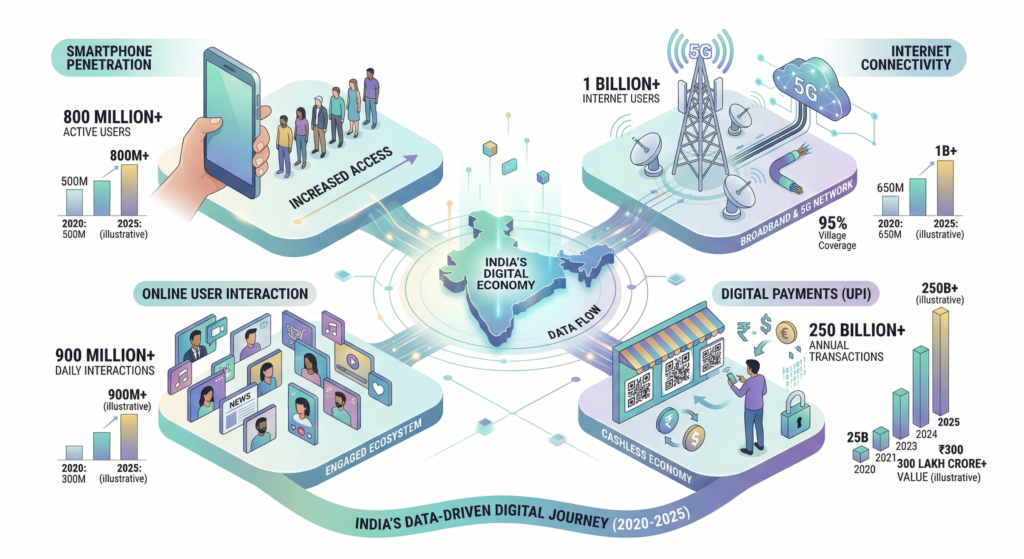
One of the most important drivers of India’s startup boom has been the rapid expansion of the country’s digital economy.
Over the past decade, India has undergone an extraordinary digital transformation fueled by:
- affordable smartphones
- inexpensive mobile data
- expanding internet access
- government-backed digital infrastructure
“India’s startup ecosystem is now deep, diverse, and built for long-term value.” – — Sanjeev Bikhchandani
India now has more than 800 million internet users, creating one of the largest connected populations in the world. This digital foundation has opened the door for startups building online-first businesses across sectors such as e-commerce, payments, logistics, and education technology.
Government initiatives such as Digital India and the development of the India Stack digital infrastructure have further accelerated innovation. Platforms like Aadhaar, UPI, and digital identity systems have enabled startups to build services on top of shared national infrastructure.
This environment has allowed entrepreneurs to launch companies capable of scaling to millions of users within a relatively short period of time.
At the same time, this aligns with insights from startup funding trends, where capital allocation is becoming more disciplined.
A Deep Pool of Engineering Talent
Another key factor behind India’s startup growth is its vast pool of technical talent.
India produces hundreds of thousands of engineers every year from universities and technology institutes across the country. Many of these engineers have gained experience working in global technology companies, including multinational firms that operate large engineering centers in cities such as Bengaluru, Hyderabad, Pune, and Gurgaon.
These professionals bring with them expertise in areas such as:
- cloud computing
- artificial intelligence
- cybersecurity
- data engineering
- enterprise software development
As a result, startups in India are able to build world-class technology products while maintaining relatively efficient cost structures compared to technology hubs like Silicon Valley.
“India is at an inflection point in building global technology companies.” — Rajan Anandan
This combination of high-quality engineering talent and cost efficiency has become one of the defining advantages of the Indian startup ecosystem.
India’s startup landscape is evolving with stronger fundamentals and global ambitions.
The Rise of Global SaaS Companies
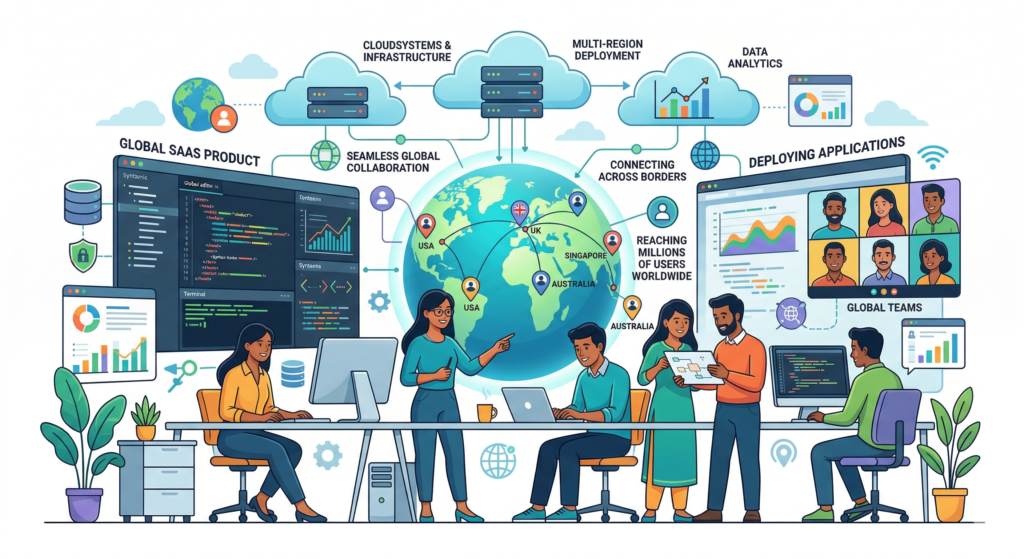
One of the most significant developments in India’s startup ecosystem has been the emergence of globally competitive SaaS (Software-as-a-Service) companies.
Startups have demonstrated that world-class enterprise software products can be built in India and sold to customers around the world.
Unlike earlier generations of technology companies that focused primarily on outsourcing services, these startups are building proprietary software platforms designed for global markets.
This shift toward product-driven companies represents an important evolution in India’s technology industry.
Many founders now follow a “global-first” strategy, designing products that serve international customers from the very beginning. In this model, engineering teams are often based in India while sales and marketing operations operate closer to major customer markets such as North America and Europe.
The success of these companies has inspired a new generation of entrepreneurs to pursue similar global ambitions.
In addition, founders can leverage insights from go-to-market strategies to scale globally.
Increasing Venture Capital Investment
Venture capital has played a crucial role in accelerating India’s startup ecosystem.
Over the past decade, global investment firms have significantly expanded their presence in India. Major venture capital funds including Sequoia Capital, Accel, Lightspeed, Tiger Global, and SoftBank have backed hundreds of Indian startups.
Domestic venture funds have also grown in prominence, helping support early-stage founders across sectors such as fintech, SaaS, deep technology, and artificial intelligence.
The availability of venture funding has enabled startups to:
- scale rapidly
- invest in product development
- expand into international markets
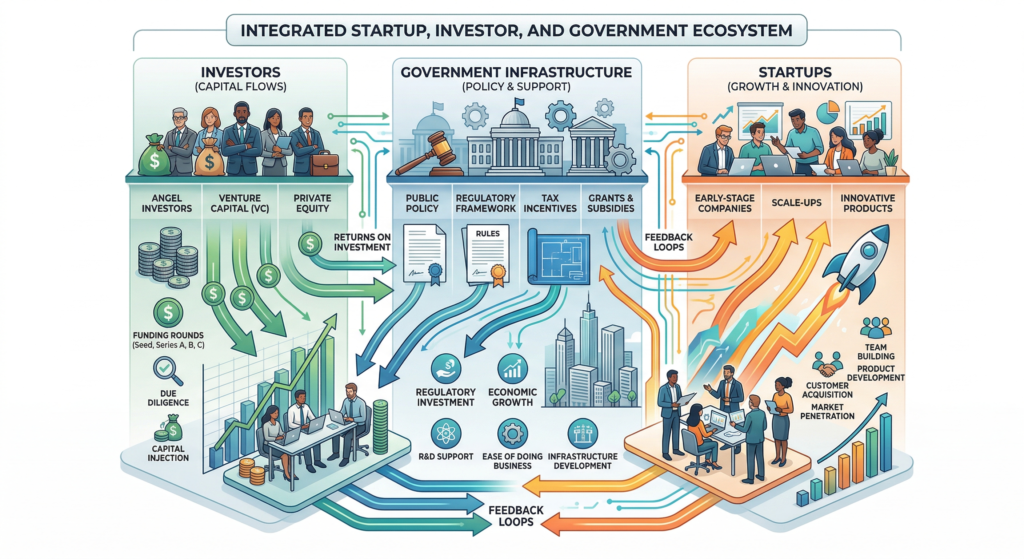
At the same time, the ecosystem has also matured to include angel investors, incubators, accelerators, and startup-focused venture studios.
These networks provide mentorship, capital, and operational guidance to early-stage founders, increasing the likelihood that promising ideas can develop into scalable businesses.
As the startup ecosystem in India matures, founders are focusing more on sustainable growth.
As Kunal Bahl has observed, “India is seeing a new generation of founders building for scale,” reflecting a shift in entrepreneurial ambition.
Government Support for Innovation
Government policy has also played an important role in strengthening India’s startup ecosystem.
Programs such as Startup India have introduced policy frameworks designed to encourage entrepreneurship. These initiatives include tax benefits for startups, simplified compliance processes, and funding support for early-stage innovation.
India has also seen the growth of technology incubators and research centers associated with universities and public institutions. These organizations help translate academic research into commercial technology products.
In emerging sectors such as artificial intelligence, biotechnology, and semiconductor technology, public-private collaboration is increasingly becoming an important catalyst for innovation.
Ultimately, the India startup ecosystem is positioned to become a key driver of economic growth.
A New Generation of Ambitious Founders
Perhaps the most important factor driving India’s startup ecosystem is the emergence of a new generation of entrepreneurs with global ambitions.
Many founders today have experience working in international technology companies or have studied abroad before returning to India to build companies. Others are second-time entrepreneurs who have already experienced the startup journey and are now building more sophisticated ventures.
These founders are increasingly focused on building companies that compete globally rather than serving only domestic markets.
In sectors such as:
- AI software
- enterprise automation
- developer tools
- fintech infrastructure
“India’s talent will be central to the future of global technology.” — Rishad Premji
Indian startups are building products designed for customers across multiple continents.
This global outlook is helping reshape how investors and industry observers perceive the Indian startup ecosystem.
This also aligns with emerging trends in AI-driven innovation, where startups are building high-impact solutions.
Challenges That Still Remain
Despite its rapid growth, India’s startup ecosystem still faces several challenges.
One of the most significant constraints is access to large-scale computing infrastructure, particularly for companies working in artificial intelligence and deep technology. Compared with the United States and China, India still has fewer large research labs and high-performance computing resources.
Another challenge is late-stage funding availability. While early-stage venture capital has become more accessible, many startups still struggle to secure large growth-stage investments.
Regulatory complexity can also create friction for startups navigating compliance requirements across multiple jurisdictions.
However, these challenges are gradually being addressed as the ecosystem continues to mature.
The Next Phase of India’s Startup Ecosystem
Industry observers believe that the next decade could be transformative for India’s technology ecosystem.
Several trends suggest that India’s role in global innovation may continue to expand:
- rapid adoption of artificial intelligence technologies
- growth of enterprise software companies
- increasing global demand for developer tools and automation platforms
- expansion of digital infrastructure across emerging markets
As these trends unfold, Indian entrepreneurs are likely to play an increasingly influential role in shaping the global technology landscape.
According to Uday Kotak, “Entrepreneurship and capital together are shaping India’s future,” highlighting the importance of funding in the ecosystem.
A Global Innovation Powerhouse in the Making
India’s startup ecosystem has come a long way in a relatively short period of time.
What began as a small group of technology companies concentrated in a few major cities has evolved into a vibrant network of founders, investors, engineers, and innovators working across industries and geographies.
With its combination of engineering talent, digital infrastructure, entrepreneurial ambition, and growing access to capital, India is steadily emerging as one of the world’s most important centers for technological innovation.
For investors, policymakers, and entrepreneurs alike, the rise of India’s startup ecosystem represents one of the most important economic transformations of the 21st century.