
Newtrace – The Indian Startup Trying to Make Green Hydrogen Cheaper
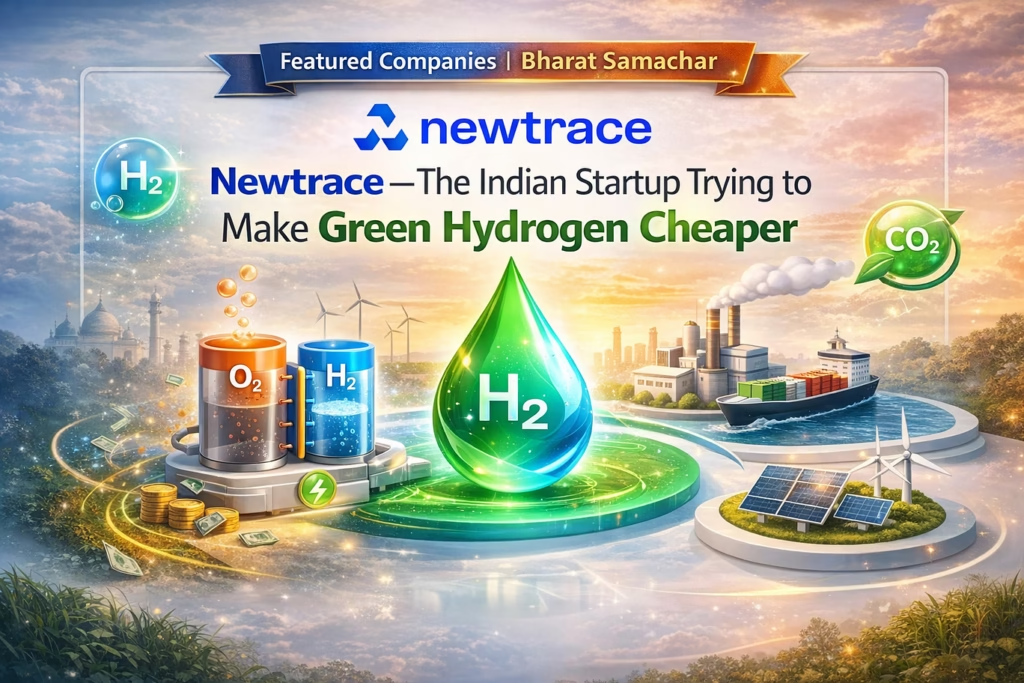
In the global race to decarbonise heavy industry and transition toward cleaner energy systems, green hydrogen has emerged as one of the most promising solutions. However, despite its enormous potential, the widespread adoption of green hydrogen has been hindered by one major obstacle: cost. Producing hydrogen using renewable energy remains significantly more expensive than conventional fossil-fuel-based methods. This is precisely the problem that Bengaluru-based climate technology startup Newtrace is attempting to solve. Founded in 2021, the deep-tech venture is building advanced electrode and electrolyser technologies designed to make green hydrogen production dramatically more efficient and affordable. By focusing on the most critical component inside hydrogen production systems, the company aims to unlock a key bottleneck in the global clean-energy transition. The Startup’s Mission Newtrace operates at the intersection of clean energy, materials science, and electrochemistry. Its mission is simple but ambitious: to reduce the cost of producing green hydrogen so that it can compete with traditional fossil-fuel-derived hydrogen Hydrogen today is widely used across industries such as fertilizer production, oil refining, and chemical manufacturing. Unfortunately, most hydrogen currently produced globally is “grey hydrogen,” which is generated using fossil fuels and emits large amounts of carbon dioxide. Green hydrogen, on the other hand, is produced by splitting water into hydrogen and oxygen using renewable electricity from sources like solar or wind. The process uses machines called electrolysers, which perform electrolysis by passing electricity through water. If the electricity used is renewable, the resulting hydrogen is considered completely clean. Despite its environmental benefits, green hydrogen production is still expensive. One of the biggest reasons for this is inefficiency in electrolyser systems, particularly in the electrode components, where much of the energy loss occurs during electrolysis. This is where Newtrace’s innovation comes into play. The Technology: Voltagen Electrodes At the heart of Newtrace’s technology is Voltagen, a proprietary electrode system designed specifically for alkaline water electrolysers. These electrodes play a crucial role in improving the efficiency of hydrogen production. Voltagen electrodes are engineered to deliver several key improvements: Because the technology can be integrated into existing hydrogen production infrastructure without redesigning entire systems, it offers a practical path for manufacturers and hydrogen producers to upgrade performance quickly. The company has also developed membraneless electrolyser technology, further expanding its innovation in hydrogen production systems. According to the company’s leadership, improvements in materials science and manufacturing processes are essential for reducing hydrogen costs. As CEO and co-founder Prasanta Sarkar explained, the challenge of green hydrogen economics is fundamentally a materials and engineering problem, not just an energy one. The Founders Behind Newtrace Newtrace was founded by Prasanta Sarkar and Rochan Sinha, two engineers with deep expertise in electrochemistry, materials science, and industrial engineering. Instead of pursuing software or consumer-tech opportunities — which often dominate startup ecosystems — the founders chose a far more difficult path: building deep-tech hardware in climate technology. This requires years of research, laboratory experimentation, and industrial validation before commercial deployment. Today, the company operates out of a 30,000-square-foot facility in Bengaluru and employs more than 45 engineers and scientists working on hydrogen technology development. Funding and Investor Support Newtrace recently announced a $6.3 million Pre-Series A funding round, marking an important milestone in the company’s growth journey. The round was led by HDFC Bank and Mitsui Sumitomo Insurance Venture Capital, highlighting growing institutional interest in climate technology innovation. The funding round also saw participation from several existing investors, including: Prior to this round, the startup had already raised around $5.7 million in seed funding in 2023, bringing its total funding to roughly $12 million to date. The new capital will be used to: The company expects to begin initial commercial deliveries of Voltagen electrodes within the next 12 months, marking the transition from research to large-scale commercialization. Why Green Hydrogen Matters The importance of startups like Newtrace extends far beyond the company itself. Green hydrogen is increasingly seen as a cornerstone of the global clean energy transition. Unlike electricity, which is difficult to store and transport over long distances, hydrogen can serve as a clean energy carrier for heavy industries that are difficult to electrify. Key sectors where green hydrogen could play a transformative role include: Recognizing this potential, the Indian government launched the National Green Hydrogen Mission, which aims to make India a global hub for hydrogen production. The initiative includes billions of rupees in incentives to accelerate research, infrastructure, and manufacturing in the sector. Startups like Newtrace are expected to play a critical role in achieving these ambitions by building the core technologies required to scale hydrogen production. The Road Ahead Newtrace now stands at a crucial point in its journey. Having demonstrated the science behind its technology, the company is moving toward industrial-scale manufacturing and commercialization. If successful, its innovations could help reduce the cost of green hydrogen significantly — making it viable for widespread industrial adoption. That would not only position Newtrace as a major player in the emerging hydrogen economy but could also help India establish itself as a global hub for clean energy technology. In many ways, the startup represents a broader shift happening across India’s innovation ecosystem: a growing willingness to tackle deep, complex scientific problems that have global impact. And if Newtrace succeeds, the impact could extend far beyond a single company — helping bring the world one step closer to a cleaner energy future.
InspeCity: How Indian Engineers Are Solving the Satellite Junk Problem in Space

As the global space economy accelerates, the number of satellites orbiting Earth has grown dramatically. Thousands of satellites now power navigation systems, communication networks, climate monitoring, and national security infrastructure. Yet alongside this growth comes a serious and increasingly urgent challenge: space debris and aging satellites. Many satellites stop functioning long before they leave orbit, creating a growing cloud of inactive spacecraft and debris that threatens operational satellites. According to industry estimates, more than 8,000 satellites currently orbit Earth, and thousands more are expected to launch in the coming decade. The risk of collisions is rising, and the cost of replacing satellites remains extremely high. This is the problem that InspeCity, an emerging Indian space technology startup, is determined to solve. Founded by a group of engineers with deep expertise in spacecraft systems, the company is developing satellite life-extension and servicing technologies that allow satellites to be maintained, repaired, and extended while already in orbit. In doing so, InspeCity is entering what many experts believe could become a multi-trillion-dollar space services industry in the coming decades. The Challenge of Space Debris and Aging Satellites Satellites are expensive assets. Building and launching even a small satellite can cost tens of millions of dollars. Once deployed into orbit, satellites are expected to operate for years, sometimes decades. However, many satellites stop functioning early due to relatively minor issues such as fuel depletion, component failures, or software problems. When satellites fail, they often remain in orbit as space debris, posing a threat to active spacecraft. Even small pieces of debris can travel at speeds exceeding 28,000 kilometers per hour, making collisions potentially catastrophic. The growing density of objects in orbit has raised concerns about a phenomenon known as the Kessler Syndrome, where cascading collisions create an uncontrollable chain reaction of debris. Preventing this scenario has become a priority for space agencies and satellite operators worldwide. Traditionally, if a satellite stops working or runs out of fuel, the only option is to launch a replacement. However, launching satellites is costly and time-consuming. A far more efficient solution is to service satellites directly in space — refueling them, repairing them, or extending their operational life. This emerging concept, known as on-orbit servicing, is where InspeCity is focusing its efforts. The Technology Behind InspeCity InspeCity is developing satellite servicing spacecraft and robotic technologies capable of performing maintenance tasks in orbit. These systems are designed to rendezvous with existing satellites and perform a range of operations that were previously impossible once a satellite had been launched. The startup’s technology focuses on three key capabilities: 1. Satellite Inspection InspeCity’s systems can approach satellites in orbit and conduct high-resolution inspections using advanced sensors and cameras. This allows operators to diagnose problems such as damaged components, structural issues, or fuel leaks. 2. Satellite Life Extension One of the most valuable capabilities the company is building is life-extension technology. Many satellites become unusable simply because they run out of propellant used for orbital adjustments. InspeCity aims to develop systems that can refuel satellites or attach propulsion modules, enabling them to continue operating for years longer. 3. Satellite Servicing and Debris Management The company is also working on technologies that could eventually enable repairs, upgrades, and debris mitigation, helping reduce the growing problem of space junk. By enabling these capabilities, InspeCity hopes to transform satellites from disposable assets into maintainable infrastructure, similar to how aircraft are serviced and maintained throughout their operational life. The Founders and Vision Behind the Startup InspeCity was founded by Indian aerospace engineers and researchers with backgrounds in spacecraft design, orbital mechanics, and robotics. Their vision is to build India’s first advanced in-orbit servicing platform. The founders recognized a major gap in the global space ecosystem. While many companies focus on launching satellites, very few are developing the infrastructure needed to maintain and service satellites after launch. Their long-term goal is to position InspeCity as a leader in space infrastructure services, providing mission-critical support for satellite operators worldwide. The company is currently headquartered in India and works closely with research institutions and engineering teams focused on next-generation space systems. Funding and Investor Backing InspeCity recently secured approximately $5.6 million in seed funding, marking a significant milestone for the young space technology startup. The funding round was led by prominent Indian investor Ashish Kacholia, along with participation from other strategic investors. This investment reflects growing interest in India’s private space technology ecosystem, which has expanded rapidly following policy reforms that opened the space sector to private companies. The funding will help InspeCity accelerate several critical areas of development, including: The capital will also support partnerships with satellite manufacturers and operators, allowing the company to validate its technology with real-world industry applications. India’s Growing SpaceTech Ecosystem InspeCity is part of a new wave of Indian space startups emerging after the Indian government opened the space sector to private players in 2020. Through initiatives led by IN-SPACe and other regulatory reforms, India has encouraged startups to develop commercial space technologies. Over the past few years, India has seen the rise of several space startups focusing on areas such as launch vehicles, satellite manufacturing, and geospatial data. However, satellite servicing and life-extension technology remain relatively unexplored, making InspeCity one of the few companies tackling this challenge. As the global space economy is projected to exceed $1 trillion by 2040, infrastructure services such as satellite maintenance, orbital logistics, and debris management are expected to become critical components of the industry. The Future of On-Orbit Servicing The concept of servicing satellites in space is rapidly gaining attention worldwide. Major space agencies and commercial companies are investing heavily in technologies that enable in-orbit maintenance, refueling, and debris removal. Companies in the United States and Europe have already begun testing early versions of servicing missions. However, the market remains largely untapped, leaving enormous opportunities for innovative startups. If successful, InspeCity could become one of the pioneers of India’s space servicing industry, providing solutions that extend satellite lifespans, reduce space debris, and dramatically lower costs for satellite operators. In doing so, the startup could help shape a new era in the space economy — one where satellites are no longer discarded after a few years but maintained as long-term infrastructure in
Aheesa Digital Innovations: Powering India’s Quiet Semiconductor Revolution
For decades, the global semiconductor industry has been dominated by a handful of countries, with chip design and manufacturing concentrated in regions such as the United States, Taiwan, South Korea, and parts of Europe. Yet as digital infrastructure expands and geopolitical tensions reshape global supply chains, countries around the world are seeking to build their own semiconductor capabilities. India is no exception. With its growing digital economy, expanding telecommunications infrastructure, and rapid adoption of emerging technologies like artificial intelligence and edge computing, the country has recognised the strategic importance of semiconductor self-reliance. Amid this shift, a new generation of deep-tech startups is emerging to build India’s chip design ecosystem. One such company is Aheesa Digital Innovations, a semiconductor startup focused on developing RISC-V networking chips designed for broadband routers and edge computing systems. Though still early in its journey, Aheesa represents an important step in what many analysts describe as India’s quiet semiconductor revolution. Building the Chips Behind the Internet At its core, Aheesa Digital Innovations is a semiconductor design company. The startup focuses on developing specialised networking chips that enable broadband routers, telecommunications equipment, and edge computing devices to process large volumes of data efficiently. As internet usage grows rapidly across India — driven by affordable smartphones, digital services, and expanding fiber networks — the demand for high-performance networking hardware continues to rise. Routers, switches, and edge computing devices require powerful processors capable of managing large amounts of network traffic while maintaining low latency. Aheesa is developing chips specifically designed to power this next generation of networking infrastructure. Unlike many conventional processors, the company’s chips are built using the RISC-V architecture, an open-source instruction set that is gaining popularity across the semiconductor industry. The Rise of RISC-V Traditionally, most processors used in computing devices rely on proprietary architectures such as x86 (developed by Intel and AMD) or ARM, which require licensing agreements with the companies that control them. RISC-V offers a different approach. As an open and customizable architecture, it allows companies to design processors without paying licensing fees while tailoring chips to specific applications. This flexibility has made RISC-V particularly attractive for emerging sectors such as: By building chips on the RISC-V architecture, Aheesa can develop highly specialised processors optimized for networking workloads, rather than relying on generic processors designed for multiple applications. This approach allows hardware manufacturers to improve performance, reduce costs, and maintain greater control over their technology stack. Why Networking Chips Matter While semiconductor discussions often focus on smartphones, GPUs, or AI processors, networking chips are equally critical to modern digital infrastructure. Every time data travels across the internet — whether during a video call, streaming service, or cloud transaction — networking processors manage and route that data efficiently. As India expands its digital infrastructure through initiatives such as BharatNet and nationwide fiber deployment, the demand for networking hardware is increasing rapidly. Edge computing is also emerging as a key driver. Instead of sending all data to centralized cloud servers, edge computing processes data closer to where it is generated, reducing latency and improving performance for applications such as smart cities, industrial automation, and connected devices. These systems require high-performance networking processors capable of handling massive data flows, creating opportunities for specialised semiconductor companies like Aheesa. The Vision Behind Aheesa Aheesa Digital Innovations was founded with the goal of building advanced networking semiconductor solutions designed in India. The founders recognised a critical gap in India’s technology ecosystem. While the country has long been known for its software expertise, semiconductor design and hardware innovation have remained relatively underdeveloped. By focusing on deep-tech chip design, Aheesa aims to contribute to India’s efforts to establish a stronger presence in the global semiconductor industry. Rather than competing directly with global chip giants in consumer processors, the company is focusing on a niche but rapidly growing segment: networking and edge infrastructure. This strategy allows the startup to address an important market need while developing proprietary intellectual property in an industry where innovation cycles are long and complex. Government Support and Funding Recognising the importance of semiconductor development, Indian state governments and national initiatives have begun supporting deep-tech startups in the sector. Aheesa Digital Innovations recently secured ₹20 crore in seed funding from Tamil Nadu’s Emerging Sector Seed Fund, a government-backed initiative designed to support startups in strategic technology sectors. The investment highlights Tamil Nadu’s growing ambitions to become a major hub for electronics and semiconductor innovation in India. The funding will support several key areas of development, including: Because semiconductor development requires substantial research investment and long development cycles, early-stage funding is particularly critical for startups operating in this space. India’s Semiconductor Ambitions The rise of companies like Aheesa reflects a broader transformation taking place in India’s technology ecosystem. The Indian government has launched a series of initiatives aimed at strengthening the country’s semiconductor capabilities, including the India Semiconductor Mission, which seeks to attract manufacturing investments and support chip design startups. India currently imports the majority of its semiconductor requirements, making supply chains vulnerable to global disruptions. By supporting domestic semiconductor innovation, policymakers hope to reduce dependence on imports while strengthening India’s position in the global technology supply chain. While building a complete semiconductor ecosystem — including fabrication plants, design houses, and supply chains — will take years, startups like Aheesa are helping lay the foundation for this transformation. The Road Ahead The semiconductor industry is notoriously challenging, requiring deep expertise, significant capital, and long development cycles. However, it is also one of the most strategically important industries in the modern world. For Aheesa Digital Innovations, the journey ahead involves transforming cutting-edge chip designs into commercially viable products that can power the next generation of networking infrastructure. If successful, the company could become part of a new wave of Indian deep-tech innovators contributing to global semiconductor development. And while the spotlight often falls on flashy consumer technologies, the work being done by companies like Aheesa represents something equally important — the quiet but essential engineering breakthroughs that power the digital world. In many ways, Aheesa’s story is not just about one startup. It reflects a larger shift
Farmtheory: The Startup Reinventing India’s Farm Supply Chains
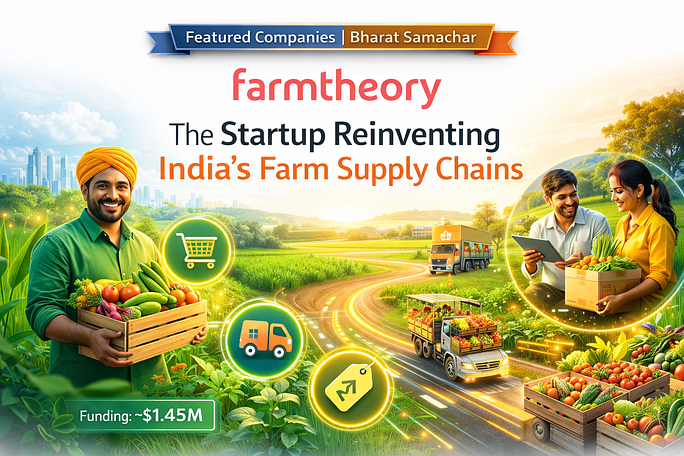
India’s agricultural sector is one of the largest in the world, employing nearly half of the country’s workforce and supporting the livelihoods of millions of smallholder farmers. Yet despite its scale and importance, the sector continues to struggle with deeply entrenched inefficiencies — fragmented supply chains, multiple intermediaries, price volatility, and limited access to markets for farmers. For decades, farmers across India have faced a common challenge: growing produce is often easier than selling it profitably. A complex network of middlemen, logistics bottlenecks, and price fluctuations often prevents farmers from receiving fair value for their crops. It is this structural problem that Farmtheory, an emerging AgriTech startup, is working to solve. By building a technology-driven farm-to-market ecosystem, the company aims to create a more transparent, efficient, and farmer-friendly agricultural supply chain. With a model that directly connects farmers to buyers while digitising supply chain operations, Farmtheory is positioning itself as one of the startups reinventing India’s agricultural marketplace. The Problem with Traditional Agricultural Supply Chains India’s agricultural supply chain is notoriously complex. A typical journey from farm to consumer involves multiple intermediaries — local traders, aggregators, wholesalers, distributors, and retailers. While these layers evolved historically to support logistics and distribution, they often reduce the share of value that ultimately reaches the farmer. Several systemic challenges affect the agricultural supply chain: For small farmers, these inefficiencies can translate into unstable incomes and limited bargaining power. Recognising these challenges, a new generation of AgriTech startups is working to modernise agricultural supply chains using technology, data, and digital platforms. Farmtheory is among the companies taking a comprehensive approach to solving this problem. Building a Tech-Enabled Farm-to-Market Ecosystem Farmtheory’s core idea is simple but powerful: connect farmers directly with buyers through a digitally integrated supply chain platform. The company is developing a platform that links farmers, buyers, and logistics partners into a streamlined ecosystem that simplifies agricultural trade. Through this system, farmers can access: For buyers — including retailers, food companies, and distributors — the platform provides reliable access to fresh agricultural produce while improving supply chain traceability. By reducing the number of intermediaries involved in agricultural transactions, Farmtheory aims to ensure that farmers receive better prices while buyers benefit from more efficient sourcing. Empowering Small Farmers A key focus of Farmtheory’s model is supporting small and medium-sized farmers, who make up the majority of India’s agricultural producers. Many of these farmers operate on small plots of land and have limited access to organised markets. They often rely on local traders who offer convenience but may not provide the best pricing. Farmtheory helps address this imbalance by giving farmers access to a wider marketplace and improving visibility into demand trends. Through digital tools and supply chain coordination, the platform helps farmers: Over time, this type of model can significantly improve farmer incomes while strengthening agricultural supply chains. Technology at the Heart of the Platform Farmtheory’s platform combines several technological components designed to optimise agricultural commerce. These include: Digital Marketplace Farmers and buyers can connect directly through a digital platform that facilitates transactions and ensures transparency in pricing and supply availability. Supply Chain Coordination The platform helps coordinate logistics, ensuring that produce can be transported efficiently from farms to buyers. Data and Demand Forecasting By analysing demand trends, the system can help farmers plan crop production more effectively and reduce oversupply or shortages. Quality and Traceability For buyers, traceability and quality assurance are increasingly important. Farmtheory’s model allows buyers to track the origin of produce and ensure consistent quality. This integration of technology into agricultural supply chains is transforming what was historically a fragmented and manual ecosystem. Funding and Investor Support Farmtheory has attracted early investor interest as part of India’s rapidly growing AgriTech ecosystem. The startup has raised approximately $1.45 million in seed funding, with the round led by Merak Ventures, a venture capital firm focused on supporting early-stage startups in emerging sectors. The funding will allow the company to expand its platform capabilities and scale operations across additional agricultural regions. Key areas where the investment will be used include: For AgriTech startups like Farmtheory, early funding is critical for building networks and infrastructure that enable supply chain transformation. India’s Growing AgriTech Ecosystem Farmtheory is part of a broader wave of innovation taking place in India’s agricultural sector. Over the past few years, AgriTech has emerged as one of the most promising segments within the startup ecosystem. From precision agriculture and farm analytics to digital marketplaces and supply chain platforms, startups are exploring ways to modernise agriculture through technology. India’s agricultural sector represents a massive opportunity for innovation, with a market estimated to exceed hundreds of billions of dollars annually. Government initiatives aimed at improving digital agriculture, strengthening farmer networks, and modernising supply chains have also created a favourable environment for AgriTech startups. Companies like Farmtheory are building solutions that combine technology with deep agricultural expertise, enabling them to tackle long-standing inefficiencies in the sector. The Road Ahead While transforming agricultural supply chains is a complex challenge, the potential impact of solutions like Farmtheory’s is enormous. If successful, the company could help create a more efficient agricultural ecosystem where farmers receive better prices, buyers gain reliable supply access, and consumers benefit from improved food distribution. As digital technologies continue to reshape traditional industries, agriculture is increasingly becoming a frontier for innovation. And in that transformation, startups like Farmtheory are playing a crucial role — building the platforms and systems that could define the future of India’s agricultural economy. By bridging the gap between farmers and markets, Farmtheory is not just building a startup. It is helping reimagine how food moves from farm to market in modern India. New boost
Contineu: How Indian Startups Are Building the Backbone of Enterprise AI

Contineu is developing an AI-driven platform designed to help enterprises deploy machine learning solutions efficiently and reliably. Rather than requiring companies to build AI infrastructure from scratch, the platform provides tools that streamline the entire lifecycle of machine learning development. These capabilities typically include: Model Development and Integration The platform helps enterprises integrate machine learning models into their existing technology stacks, enabling teams to move from experimentation to production environments more quickly. Data Pipeline Management Data is the foundation of any AI system. Contineu’s infrastructure supports the processing, organisation, and management of data required for machine learning applications. Deployment and Scaling The platform allows enterprises to deploy AI models across different environments — including cloud infrastructure, edge devices, and enterprise systems — while ensuring performance and scalability. Monitoring and Performance Optimization Once AI models are deployed, they require continuous monitoring to maintain accuracy and reliability. Contineu’s platform helps organisations track model performance and update systems as needed. By integrating these capabilities into a unified platform, Contineu aims to make AI adoption more accessible for enterprises across multiple industries. Enabling AI Across Industries The potential applications of enterprise AI are vast. Companies across sectors are increasingly exploring machine learning solutions to improve efficiency, optimise operations, and unlock new insights from data. Industries where AI adoption is accelerating include: However, many organisations lack the internal infrastructure needed to operationalise these capabilities. Platforms like Contineu aim to bridge that gap by providing AI infrastructure that enterprises can deploy without building complex systems internally. The Founders and the DeepTech Approach Contineu was founded by engineers and technology entrepreneurs with backgrounds in artificial intelligence, data engineering, and enterprise software systems. The team recognised that while AI research has advanced rapidly, enterprise adoption requires a different kind of innovation — one focused on infrastructure, reliability, and scalability. Instead of building consumer-facing AI applications, the company chose to focus on a deeper layer of the technology stack: the infrastructure that powers enterprise AI systems. This approach reflects a broader trend in the global AI ecosystem, where many startups are shifting from building standalone AI applications to developing the underlying tools and platforms that enable AI adoption at scale. Early Funding and Investor Support Contineu has secured approximately $1.2 million in early-stage funding, with investment led by SenseAI Ventures, a venture capital firm known for backing AI and deep-tech startups. The funding is expected to support several key areas of development: Early-stage funding is particularly important for deep-tech startups like Contineu, as building infrastructure platforms requires significant research, engineering effort, and product development before large-scale commercial deployment. India’s Emerging Role in the Global AI Ecosystem India has long been recognised for its strong software engineering talent and growing technology sector. In recent years, the country has also begun to establish itself as an important player in the global artificial intelligence ecosystem. Indian startups are increasingly developing AI solutions not only for domestic markets but also for global enterprises. Several factors are contributing to this shift: Within this landscape, deep-tech companies like Contineu are focusing on building foundational AI infrastructure that can support enterprise innovation across industries. The Future of Enterprise AI Artificial intelligence is still in the early stages of its enterprise transformation. While many companies have begun experimenting with AI, the next phase of adoption will depend on reliable infrastructure that makes machine learning systems easier to deploy and manage. Startups like Contineu are working at this critical intersection between AI innovation and enterprise technology adoption. By building platforms that simplify the deployment of machine learning systems, the company aims to help organisations unlock the full potential of AI without the complexity that often accompanies it. In the coming years, as AI becomes embedded in everyday business operations, the importance of infrastructure platforms will only grow. And as enterprises around the world seek scalable ways to integrate artificial intelligence into their operations, companies like Contineu may play a pivotal role in building the foundational systems that power the global AI economy.
Cleevo: The Rise of Smart Home Hygiene Startups in India

In recent years, hygiene has moved from being a basic household concern to becoming a central part of modern lifestyle choices. The COVID-19 pandemic dramatically reshaped how people think about cleanliness, safety, and sanitation, both in public spaces and inside their homes. Today’s consumers are not just looking for cleaning products — they are increasingly seeking smart, technology-enabled hygiene solutions that offer convenience, efficiency, and improved protection. Amid this growing demand, a new generation of startups is emerging to redefine how households manage hygiene. One such company is Cleevo, a consumer-focused startup developing smart home hygiene solutions designed for modern households. By combining product innovation with technology and design, Cleevo is positioning itself at the intersection of consumer goods, health awareness, and smart home technology — a space that is rapidly gaining momentum in India’s evolving consumer tech ecosystem. A Changing Hygiene Mindset Historically, hygiene products in India have largely been limited to traditional categories such as soaps, disinfectants, and cleaning liquids. These products have been widely used but often lacked innovation in terms of functionality or user experience. However, several trends are now transforming the hygiene market: These changes are creating opportunities for startups that can rethink hygiene products through a technology-driven lens. Instead of offering basic cleaning products, companies like Cleevo are developing smart hygiene devices and solutions that improve convenience while maintaining high standards of cleanliness. What Cleevo Does Cleevo focuses on building next-generation hygiene solutions designed for contemporary homes. The company’s product approach centers around combining technology, automation, and modern design to make hygiene management simpler and more effective for households. While traditional hygiene products rely on manual use, Cleevo’s solutions aim to introduce features such as: These innovations reflect a broader shift in consumer expectations. As homes become more technologically integrated — with smart lighting, connected appliances, and digital assistants — hygiene systems are also evolving to become part of the smart home ecosystem. Cleevo aims to be part of that transition by creating products that combine functionality, technology, and aesthetic design. The Rise of Smart Hygiene Products Globally, the market for smart home technologies has expanded rapidly over the past decade. From smart thermostats and connected security systems to automated lighting and voice-controlled appliances, technology is reshaping everyday living environments. Hygiene is becoming the next frontier in this evolution. Touchless technologies, for example, have become increasingly popular in both commercial and residential settings. Automatic dispensers, sensor-based sanitation systems, and smart cleaning devices are now being adopted in homes, offices, and public spaces. In India, this trend is still in its early stages, creating opportunities for startups to introduce innovative products tailored to local consumer needs. Companies like Cleevo are exploring how technology can make hygiene management more efficient, more convenient, and more accessible for modern households. Early Funding and Investor Interest Cleevo has already begun attracting attention from early-stage investors interested in consumer technology and smart home innovation. The startup has raised approximately $1 million in early funding, helping support product development and initial market expansion. Early investment is crucial for consumer product startups, particularly those building hardware-based solutions. Developing and manufacturing physical products requires investment in areas such as: With early funding in place, Cleevo is now focused on refining its product offerings and expanding its presence in India’s growing smart home and hygiene markets. India’s Emerging Consumer Tech Landscape India’s consumer technology ecosystem has evolved significantly over the past decade. While the startup ecosystem was once dominated by sectors such as e-commerce and fintech, new categories are now emerging in areas such as health technology, home automation, and smart lifestyle products. Several factors are driving this shift: Urban households, in particular, are becoming early adopters of smart home technologies. As consumers seek products that combine convenience with improved living standards, startups like Cleevo are exploring new ways to innovate within everyday household categories. Building a Brand Around Modern Hygiene Beyond product innovation, Cleevo is also focused on building a brand that resonates with modern consumers. Today’s consumers increasingly value products that combine functionality, sustainability, and thoughtful design. Companies in the smart home space must not only deliver effective solutions but also create products that integrate seamlessly into contemporary lifestyles. Cleevo’s approach reflects this philosophy, focusing on hygiene products that are: By blending consumer technology with everyday hygiene needs, the startup is aiming to build a category that remains relatively underdeveloped in India. The Future of Smart Hygiene The concept of smart hygiene systems is still in its early stages, but the potential for growth is significant. As health awareness continues to rise and homes become increasingly connected, demand for intelligent sanitation solutions is expected to expand. For startups like Cleevo, this represents an opportunity to build entirely new product categories that sit between consumer electronics, health technology, and home appliances. In the years ahead, smart hygiene systems could become as common in households as smart lighting or automated security systems. And as India’s consumer technology ecosystem continues to evolve, companies like Cleevo may play an important role in shaping how households approach cleanliness, health, and daily living. What began as a response to changing hygiene habits may ultimately become a new frontier in smart home innovation.